Cave de Genève
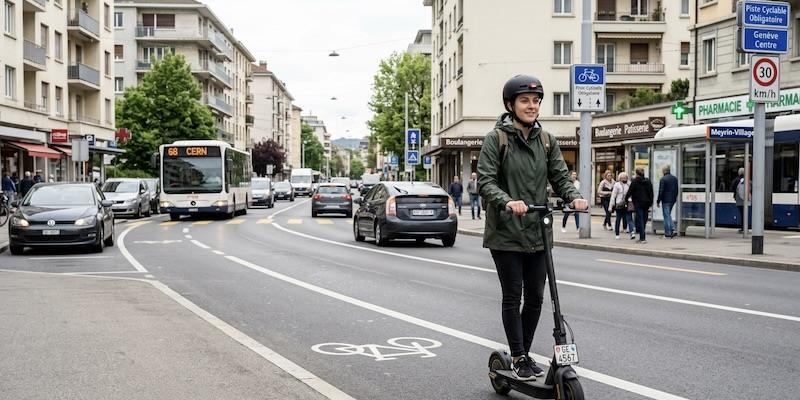
The rapid rise of electric scooters in our urban centres has profoundly changed everyday mobility, while also creating a palpable climate of tension among the different users of public space. What was meant to embody an eco-friendly answer to urban congestion has, for many, become a symbol of road anarchy. This sense of disorder stems above all from behaviour perceived as cavalier, with users appearing to shed the constraints imposed on motorists while remaining oblivious to the vulnerability of pedestrians. Yet, contrary to the widespread belief that the legal framework is absent or unclear, these vehicles are now tightly regulated : in France by the Highway Code, in Switzerland by the Federal Road Traffic Act, even if that regulation suffers from a lack of awareness and, above all, consistent enforcement on the ground.
The rule is unambiguous on both sides of the border: electric scooters have no place on the pavement, which is reserved for pedestrians, and riding on it is an offence punishable by a fine. Using cycle lanes and cycle tracks is a legal requirement wherever they are available. In Switzerland, the scooter is classified as a “light moped” and subject to the same rules as conventional bicycles, with a maximum speed of 20 km/h and motor power capped at 500 watts, stricter thresholds than in France, where the limit is 25 km/h with no power restriction. At that speed, a scooter is neither a toy nor a leisure accessory: it is a motor vehicle in its own right. That is precisely where the most dangerous confusion lies. The frequent disregard for red lights, riding the wrong way down one-way streets, and weaving between vehicles all reflect a persistent psychological misunderstanding: riders still see themselves as upgraded pedestrians rather than drivers of a motorised vehicle subject to the ordinary rules of the road. This confusion leads to serious incidents, most notably when carrying a passenger, a practice formally prohibited in both Switzerland and France, and reaches its peak after dark, when the outline of a scooter becomes almost invisible to drivers if the required equipment is not in use. The law nonetheless requires front and rear lights to remain on at all times, along with reflectors and a high-visibility vest whenever visibility is poor. Too often, riders are seen dressed in dark clothing with no active lighting, moving like shadows along country roads or ring roads. The situation in Geneva illustrates the scale of the problem with particular clarity: the cantonal gendarmerie seizes an average of one hundred scooters per month — nearly 1,500 a year, and not a single owner has ever been able to reclaim their vehicle. The reason is stark: almost all models sold on the market are technically impossible to bring into compliance, with most capable of reaching 45 km/h and some up to 100 km/h, and all easily derestricted within seconds via a Bluetooth remote or a simple smartphone app. This level of non-compliance points to a structural failure: the market itself is the problem, with manufacturers selling vehicles designed to circumvent legal standards and leaving users, often poorly informed, with the impossible task of bringing them into line.
Faced with a growing number of accidents and seizures, a collective awakening is needed before legislation becomes even more restrictive. The question of compulsory registration and helmet-wearing in cities, not currently required in Switzerland for scooters, regularly resurfaces in public debate as a means of holding owners to account. Some European cities have already acted: Paris ended its shared scooter concession in 2023 following a consultative vote, while other capitals are piloting geofencing systems that automatically reduce speed near pedestrian zones. In Switzerland, the Federal Council revised the rules on light mopeds on 1 July 2025 without changing the thresholds applicable to scooters, which remain capped at 20 km/h, a clear signal that these vehicles are to be treated differently from others in the same category. Without more systematic enforcement against dangerous behaviour, stronger road safety education for younger riders, and greater accountability from retailers and distributors, public hostility towards these vehicles will only grow.
The future of electric scooters in cities will ultimately depend on riders’ willingness to make a decisive mental shift: from individual opportunism to a genuinely shared sense of road responsibility. Sharing the road is possible. It simply cannot come at the cost of other people’s lives.

Find all our Inside articles