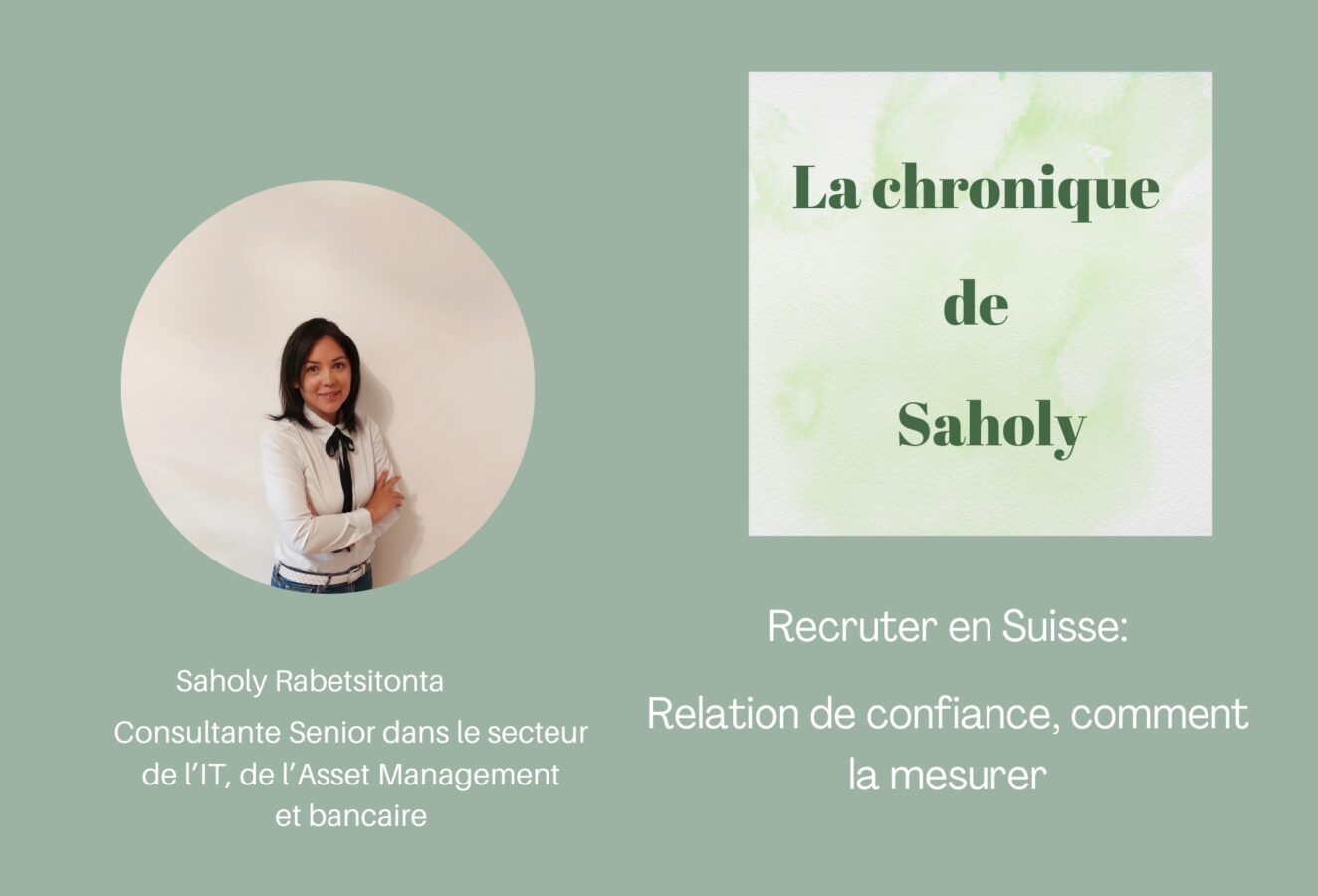
In Switzerland, and more particularly in Geneva, recruitment is evolving within an economic environment shaped by fiercer competition, increasingly fragmented career paths and sustained cross-border pressure. In this context, trust between recruitment specialists, candidates and companies has become the cornerstone of efficient, fair and sustainable processes. It is also a decisive competitive advantage in a demanding Swiss market, where reputation remains a key intangible asset. This raises the question of how to measure the trust relationship between a recruitment expert and their clients.
In an ecosystem strongly shaped by cross-border commuter flows (109,000 in Geneva, 27,500 in the canton of Vaud), recruitment is no longer simply a local matter. The triangular relationship between candidates, recruitment firms and companies must be based on clear, measurable and monitored commitments.
To that end, we distinguish between qualitative and quantitative indicators, which we will examine in greater detail in the second part.
Beyond the numbers, trust rests on qualitative indicators that are particularly sensitive in Swiss culture, where reliability, precision and respect for confidentiality are deeply rooted.
For companies, trust may be reflected in more comprehensive job briefs at the outset, the granting of exclusive mandates, and the acceptance of the recruiter’s advice on hiring strategy.
To make the quality of the relationship with its partners more objective, the recruitment expert must keep their promises when meeting a prospective client, which means taking into account delivery times, compliance with agreed conditions and observed notice periods.
Post-hire analysis is also important, as the 12-month retention rate, or even less, the gap between announced and actual performance, and feedback from employers and candidates can prove significant depending on the role, the sector and the type of candidate profile.
Geographic analysis also makes it possible to measure trust by comparing practices between Geneva and Vaud, or across different sectors, in order to identify areas for improvement.
Between the recruitment expert and a company, trust is measured through quantitative indicators (NPS, retention rate, repeat business, etc.), qualitative perceptions (interpersonal skills, behaviour, transparency), field observations (exclusivity, information sharing) and tools such as questionnaires, CRM systems and dashboards.
With candidates, the level of trust can also be measured through contractual commitment, clarity on salaries, social security schemes (LAMal), working conditions and mobility. For talent, it also includes a perception that their interests are being defended fairly, transparency on selection criteria and the company’s real expectations, as well as measuring satisfaction after onboarding and the acceptance rate of offers presented through the recruitment expert.
Let us take a closer look at the ways trust can be measured.
Trust must be made objective in order to guarantee the quality of relationships between experts, companies and talent. Trust between recruitment experts, companies and candidates is neither intuitive nor automatic: it is built, structured and measured.
Those who succeed in establishing and measuring it sustainably will gain not only in efficiency, but also in legitimacy and appeal, among both companies and talent.
Whether the goal is to retain talent, anticipate changes in the world of work or meet the growing demands of employers, Swiss recruitment firms must rely on personalisation and long-term support, integrate macroeconomic and geographic data to adapt their practices, and combine technology with human intelligence.
These are the easiest to measure, and they make it possible to assess the firm’s performance and the strength of the partnership:
• 12-month retention rate (or less, depending on the sector);
• acceptance rate of offers presented by the recruiter;
• NPS (Net Promoter Score) or an equivalent client-satisfaction measure;
• average time to hire and adherence to announced deadlines;
• repeat and exclusive mandates: tangible signs of trust from companies.
In a context where the KOF employment indicator fell to 0.3 points in the third quarter of 2025 (responses from 4,400 companies), the expert must demonstrate an understanding of economic cycles in order to adjust their indicators.
• quality of briefings and exchanges;
• perceived transparency and consistency between words and actions;
• interpersonal skills, availability and professionalism;
• quality of feedback given to candidates (including in the event of rejection);
• relevance of support and listening.
These elements make it possible to assess how the relationship evolves concretely in the field:
• exclusivity granted by the company (a major sign of trust);
• quality of information shared between the parties;
• clear contractual commitment with candidates (salary, mobility, LAMal, social benefits);
• adjustments after onboarding: actual performance vs expected performance.
Comparing practices and results between Geneva, Vaud or Zurich, or across sectors (NGOs, banks, start-ups, public institutions), makes it possible to:
• identify areas for improvement;
• adapt processes according to local dynamics;
• consolidate a differentiated strategy by employment catchment area.
In a demanding Swiss market, under cross-border pressure and undergoing economic change, trust is becoming an essential and lasting driver of competitiveness. It is important to remain transparent, even in times of crisis, throughout the recruitment process because in a competitive market under pressure, trust becomes a lever of competitiveness.
It rests on three pillars:
• full transparency,
• human, personalised support,
• regular assessment through qualitative and quantitative indicators.
Trust between the players — candidates, firms and companies — becomes the foundation of successful recruitment.
Those who manage to establish it sustainably will come out stronger, able to attract, support and retain the best talent, even in uncertainty, and to strengthen their trust relationship with corporate clients.
Find all our Columns