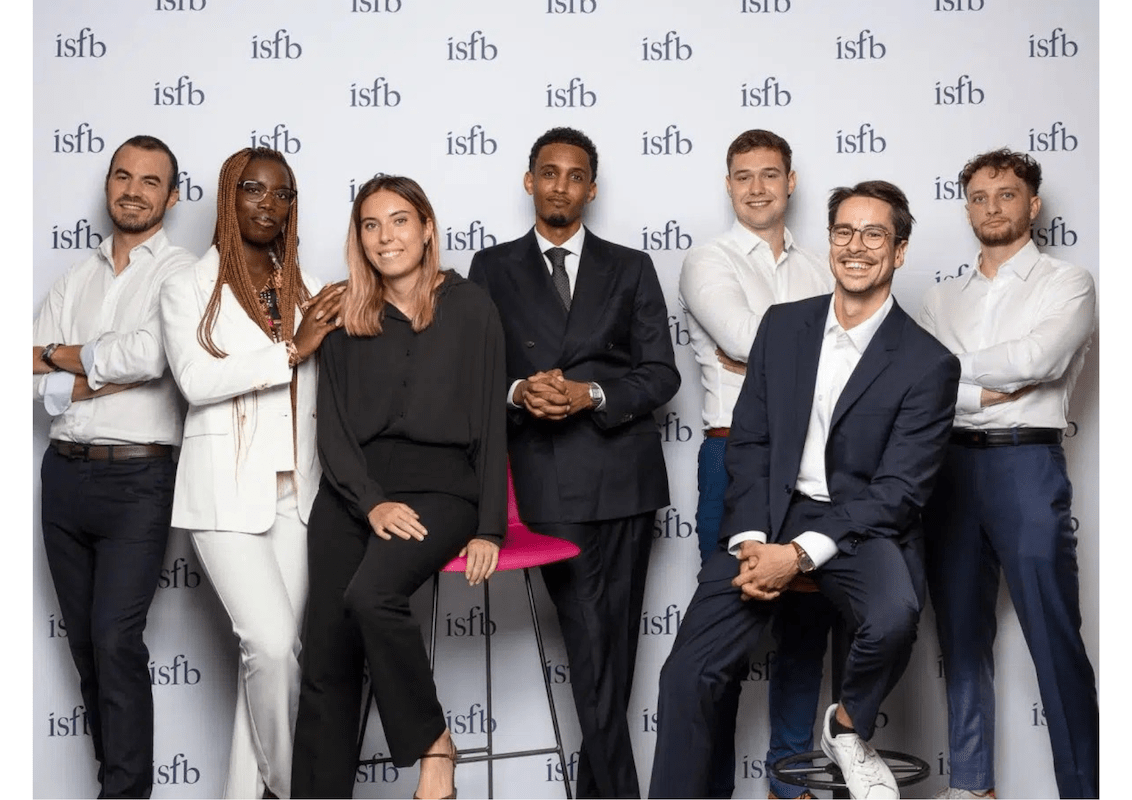
Photo © ISFB
Landing a first job after university is a demanding process that goes far beyond simply sending out applications. It first requires understanding an industry and confronting its expectations. It then means identifying its various professions and beginning to picture oneself in them with credibility. That is the logic behind the ISFB Summer School, conceived as a bridge between the academic and professional worlds, with an intensive in-person programme designed for holders, or future holders, of a bachelor’s, master’s or doctorate.
Entering the labour market after university is a major milestone, often more demanding than many expect. It is not only about securing a position, but about making a transition: leaving a relatively structured academic environment to join a professional one with its own codes, expectations and realities. In Switzerland, CSFO data show that among university graduates in economics, one in four says they encountered difficulties finding a job that matched their aspirations. The median job-search period is three months and the median number of applications reaches ten. One year after graduation, 71% are working in private services (CSFO, 2025).
In this context, the challenge is not simply to “find something”, but rather to turn an academic background into a clearly legible professional path. The ISFB Summer School responds precisely to that need by offering ten days of training, case studies, a bank visit, a hackathon, as well as preparation for HR interviews with simulations and professional coaching.

As Christophe Nicod, Head of Continuing Education at ISFB, points out, what sets this programme apart is that it does not merely provide general information about banking; it helps participants move from a view that is often vague and sometimes even idealised to a concrete understanding of the sector, the many jobs it encompasses, its requirements and what it can offer young talent. This dedicated and unique value proposition in the sector fits perfectly with the role and mission ISFB sets for itself as a professional association supporting training, skills development, employability and careers in the banking and financial sector in French-speaking Switzerland.
The programme’s strength lies in its practical nature. The Summer School does not simply deliver content on banking and finance. It also connects that content to real-world situations, industry stakeholders and tangible market expectations. In a recent testimonial, one enthusiastic participant highlighted the rare opportunity to build direct contacts with the banking world, as well as the extremely valuable support this provides in developing a career plan through a more concrete understanding of the sector and its professions.
In that sense, the ISFB Summer School is not about an implicit promise of job opportunities, but about the quality of the framework it offers to challenge one’s perception of the market and shape a truly personal, distinctive professional project. The presence of various in-house experts from member banks, as well as HR specialists from the banking sector, further enriches the opportunity on offer. It gives the programme a strong practical grounding and offers young talent a rare chance to sharpen their judgement, their posture and their understanding of the sector’s recruitment dynamics.
From the perspective of career psychology, this transition phase is especially important. Stéphane Bonzon, a career guidance psychologist within ISFB’s Career Development team, regularly stresses in his interventions that relevant support in a context of uncertainty and constant reinvention does not consist of offering a ready-made solution, but of helping individuals clarify and mobilise the resources they can rely on to become the authors of their own careers and build their own professional and personal path. This logic is particularly relevant for young graduates who must turn an academic background into a credible professional project.
From this perspective, the Summer School is no substitute for personal initiative or for the effort required when applying for jobs. Nor does it allow candidates to sidestep the selection process imposed by employers. What it can do, however, is help participants better articulate their interests, deepen their understanding of the sector they wish to join, improve the way they present themselves, and enter the labour market with greater clarity, while also having built a first relevant professional network over the two weeks of training.
As Evelyne Rechenmann, head of ISFB’s Career Development unit, notes, entering the labour market is not decided solely on academic skills. It also depends on the ability to position oneself, understand employers’ expectations and benefit from relevant support at the right time. And that time is now: the Summer School is there for that.
Programme duration: from 3 August to 14 August 2026, in Geneva
Information: www.isfb.ch/summerschool