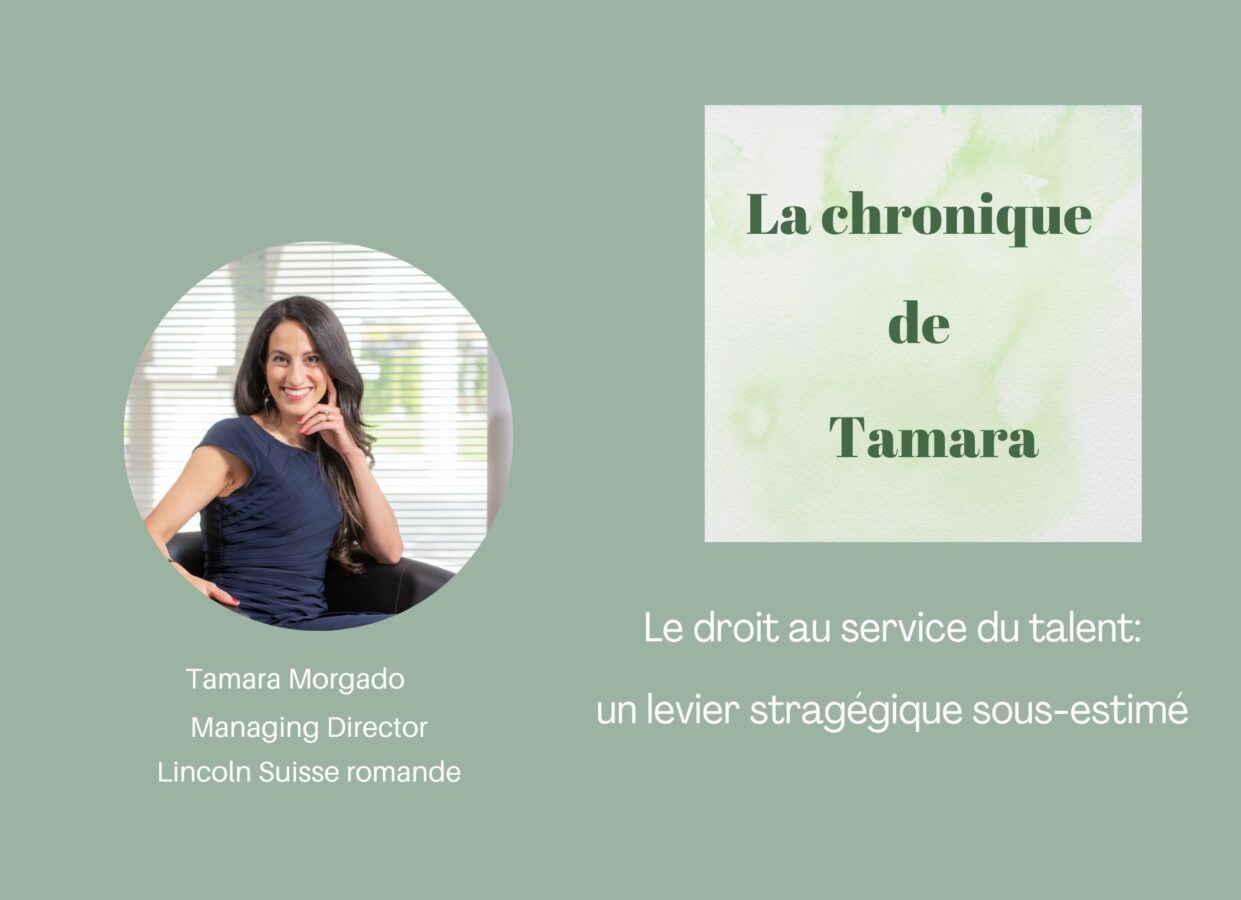
Photo T. Morgado ©
When I began my career as in-house counsel at an IT SME in Paris, I was 25 years old. By force of circumstance, I quickly combined human resources and law, working in close tandem with the company’s chief executive. He was a visionary man who already understood that my hybrid profile had a clear place in corporate strategy.
At the time, however, I felt the need to return to what I regarded as the “real profession” for which I had trained over six years: being a lawyer. I therefore returned to the bar and settled in Geneva.

Twenty years later, I am convinced that this intersection between law and talent management is a strength that companies still exploit far too little. In a context where talent is hard to retain and employee expectations are changing, organisations that bring legal thinking into their strategic reflection gain the upper hand. Law is not a constraint, but a powerful ally in talent management.
Today, in the most successful companies, HR are no longer mere process administrators. At the heart of human dynamics, they are becoming true partners in strategy.
When HR and legal teams work hand in hand, they discover that well-designed rules do not hold people back: they unlock potential, and law becomes a genuine lever of agility.
Rules are not obstacles. They create a framework. And that framework, when properly understood, is liberating.
When employees know where they stand, they feel secure. Law then becomes a foundation of trust, a tool for fairness and a pillar of corporate culture.
For nearly ten years, I have been delivering legal training to HR, management and executive teams. The conclusion is always the same: once the rules are clarified and embodied in practice, tensions ease, collaboration improves and decision-making becomes more accurate.
Conversely, ambiguity breeds misunderstanding, frustration… and often avoidable conflict. It is human: no one wants to be taken for a ride.
In an unstable labour market, what makes an employee stay is not only a project or a salary. It is the feeling of being treated fairly, within a clear environment that is consistent and aligned with their values.
A solid legal framework should not be experienced as a series of restrictions, but as a promise of stability and mutual respect. It protects individuals as much as the organisation. And it is precisely this balanced protection that creates the desire to commit for the long term.
Law is not a limit; it is control. An HR professional who understands the legal framework does not act out of fear of risk, but with confidence. Legal thinking then becomes a lever of agility.
What slows innovation is not the law. It is the fear of making mistakes, ignorance of the rules, or the belief that everything is set in stone.
By contrast, an organisation that understands the room for manoeuvre provided by the law operates with greater confidence. It experiments, adapts and communicates more effectively. Legal thinking becomes a partner of agility.
A well-designed framework makes it possible to test ideas safely, create tailor-made HR arrangements, structure flexibility and foster a calmer working environment.
The future of HR lies in close collaboration with lawyers and compliance experts. Not to make processes heavier, but to better steer human challenges within a secure framework.
What is at stake is not compliance for compliance’s sake. It is the ability to build a clear, fair and sustainable working framework – a genuine strategic advantage in a changing world of work.
Reframing the place of law in human resources also means restoring meaning to rules, not as limits to be sidestepped, but as shared benchmarks capable of supporting commitment, trust and transformation.
Every month, in this column, I will share my reflections and questions on talent management. Because recruiting and supporting talent is above all about understanding people, in order to build the company of tomorrow.
Find all our Columns