Cave de Genève

By Camilla Papaleo, Product Manager of the Genomics and Healthcare Innovators UCITS ETF at VanEck
Amazon, OpenAI, Google, Anthropic and NVIDIA are mentioned to illustrate developments in artificial intelligence and the life sciences. These companies are not held by the VanEck Genomics and Healthcare Innovators UCITS ETF as of the date of writing. References to specific companies do not constitute investment advice or a solicitation to buy or sell any security.
The most consequential recent shift in the life sciences may not be a drug approval, a clinical trial readout or a regulatory milestone. It is more structural in nature: artificial intelligence is no longer just another software tool in researchers’ hands. It is increasingly becoming part of the research infrastructure through which genetic medicine is designed, validated and developed.
In less than three months — between 14 April and 30 June 2026 — four of the world’s largest and best-capitalised AI developers launched platforms dedicated to the life sciences: Amazon, OpenAI, Google and Anthropic. Amazon Bio Discovery went live on 14 April 20261: an AI-powered cloud platform that brings together biological data ingestion, AI model selection and laboratory workflow integration in a single environment. Two days later, OpenAI launched GPT-Rosalind2, a state-of-the-art reasoning model built specifically for biology, drug discovery and medical research. Google followed on 20 May 2026 with Gemini for Science3, a broader scientific research environment whose life-sciences capabilities rely on tools such as AlphaFold, AlphaGenome and AlphaMissense. Finally, on 30 June 2026, Anthropic launched Claude Science4, a dedicated AI-powered workspace designed to help researchers analyse genetic, cellular, protein and chemical data from more than 60 scientific databases and NVIDIA’s BioNeMo Agent Toolkit.

NVIDIA, for its part, had positioned itself even earlier. BioNeMo — first launched in June 20235 and then substantially expanded in 2025 and 2026 — occupies a competitive position that is distinct and arguably more durable than that of any of its application-layer peers.
What makes this moment structurally different from previous waves of technology adoption in the life sciences is not the sophistication of any single platform, but their simultaneity. These companies, armed with significant capital, top-tier computing infrastructure and research talent, independently reached the same conclusion: the life sciences represent a major strategic frontier for AI. This consensus is not accidental. It reflects the convergence of three prerequisites that are now present at the same time: biological datasets large enough to train meaningful models, AI architectures powerful enough to extract signal from them, and a clinical and regulatory environment in which AI is increasingly used across the drug-development cycle, including in filings intended to support regulatory decision-making6. The competitive dynamics among these platforms will be decisive and are still taking shape.
The investment opportunity created by the 2026 AI platform race goes far beyond identifying the single technology company that will emerge as the main winner in AI applied to the life sciences. That question — Google versus OpenAI, or Anthropic versus Amazon — remains genuinely open and may stay that way for years. The more interesting structural observation for investors is that every platform entering this race relies on the same underlying ecosystem, and that the VanEck Genomics and Healthcare Innovators UCITS ETF (Ticker: CURE) is designed to capture several components of that ecosystem while also benefiting from the AI capabilities these platforms deploy.
The ETF tracks the MVIS® Global Future Healthcare ESG Index, which covers a broader set of healthcare innovation themes: companies generating revenue from genetic-based therapies, the technology platforms that make them possible, and the associated laboratory equipment and services7. This three-layer construction maps onto core components of the broader infrastructure supporting AI-enabled life sciences, as well as areas where AI can generate measurable commercial benefits.
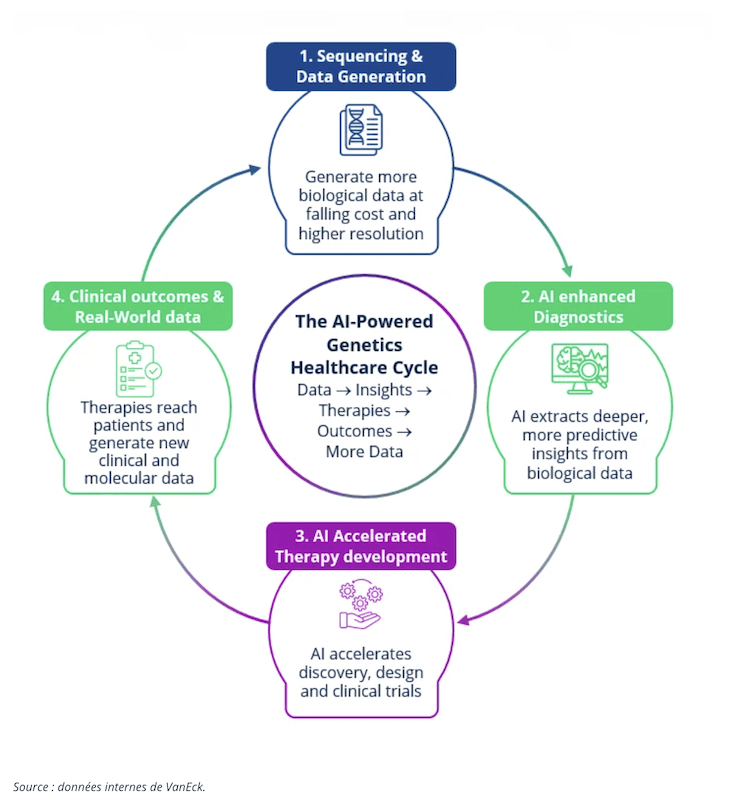
It should be noted that the relationship between AI and genetics-based healthcare is not a linear value chain. It is a self-reinforcing cycle.
Based on current third-party estimates17, the market at the intersection of AI and genetics-based healthcare could expand significantly, although these are projections and actual growth could diverge materially. The global AI-in-genomics market was valued at $1.2 billion in 2025 and is expected to reach $18.8 billion by 2033, implying a projected compound annual growth rate (CAGR) of 40.3%.
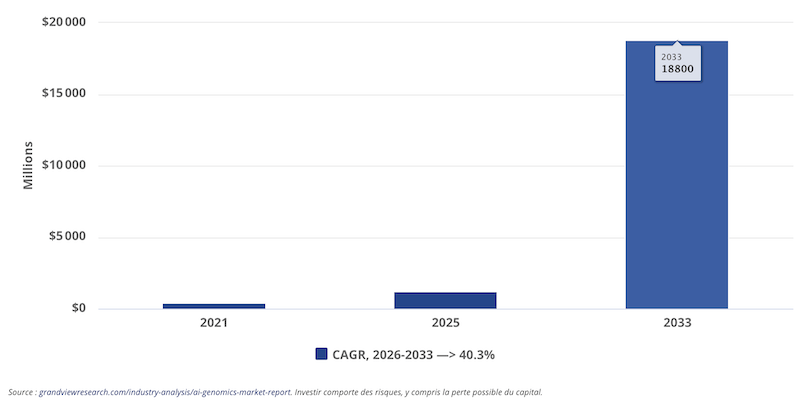
This pace of growth reflects the structural forces described by the flywheel: the expansion of genomic datasets, the acceleration of AI model development and rising demand for precision therapies. Future growth will, however, depend on factors such as clinical success, regulation, data availability, adoption by healthcare providers and companies’ ability to turn scientific advances into commercially viable products.
More broadly, the global precision medicine market was valued at $116.6 billion in 2025 and is expected to reach $405.1 billion by 2033, implying a 17.0% CAGR18 according to third-party estimates. Taken together, these figures suggest that AI is not merely accelerating an existing market: it is building a distinct, faster-growing layer on top of it. These projections are not guaranteed, however, and may not materialise as expected, with external factors likely to affect the outcome significantly.
At the same time, the regulatory environment is shifting in a way that could support this trajectory. Historically, one of the main barriers to patient access to gene therapies has been the regulatory burden: developers had to repeat costly foundational studies from scratch for each new product, even when the underlying science was already well established. The FDA took decisive steps to address this in 2026 by publishing a coherent set of guidance documents19 designed to streamline the development of gene-editing therapies and RNA-based therapies. These guidelines allow developers to build on existing scientific knowledge, pool data across related programmes and avoid unnecessary repeated testing without compromising safety standards. In addition, the FDA’s draft guidance on artificial intelligence20 establishes a risk-based credibility assessment framework for information or data generated by AI and intended to support regulatory decision-making on the safety, efficacy or quality of drugs and biological products, outlining a clearer path for AI-assisted development across the life-sciences lifecycle.
Artificial intelligence is unlikely to transform genetics-based healthcare overnight, and not every AI initiative will translate into commercial success. The history of technology adoption in the life sciences is full of tools that have accelerated research without proportionately speeding up approvals — and the clinical, regulatory and industrial bottlenecks that have always characterised this sector will not disappear simply because the discovery phase is accelerating. Investors must be careful not to confuse research productivity gains with near-term revenue.
That said, while the path forward remains uncertain, several structural conditions that could support further development continue to strengthen. Sequencing costs keep falling. Biological datasets keep expanding. The regulatory environment is evolving. And four of the world’s largest AI developers committed dedicated platforms and significant capital to the life sciences within a three-month window — a convergence that points to growing interest in AI’s potential applications across the broader life sciences landscape.
1 https://www.aboutamazon.com/
2 https://openai.com/index/
3 https://blog.google/
4 https://www.anthropic.com/
7 https://www.marketvector.
8 https://www.genome.gov/
9 https://www.illumina.com/
10 https://www.10xgenomics.
11 https://nanoporetech.com/
14 adaptivebiotech.com/our-
16 biopharmadive.com/news/
17 2025. grandviewresearch.
18 2025. grandviewresearch.
Find all our Strategic Case articles