Cave de Genève
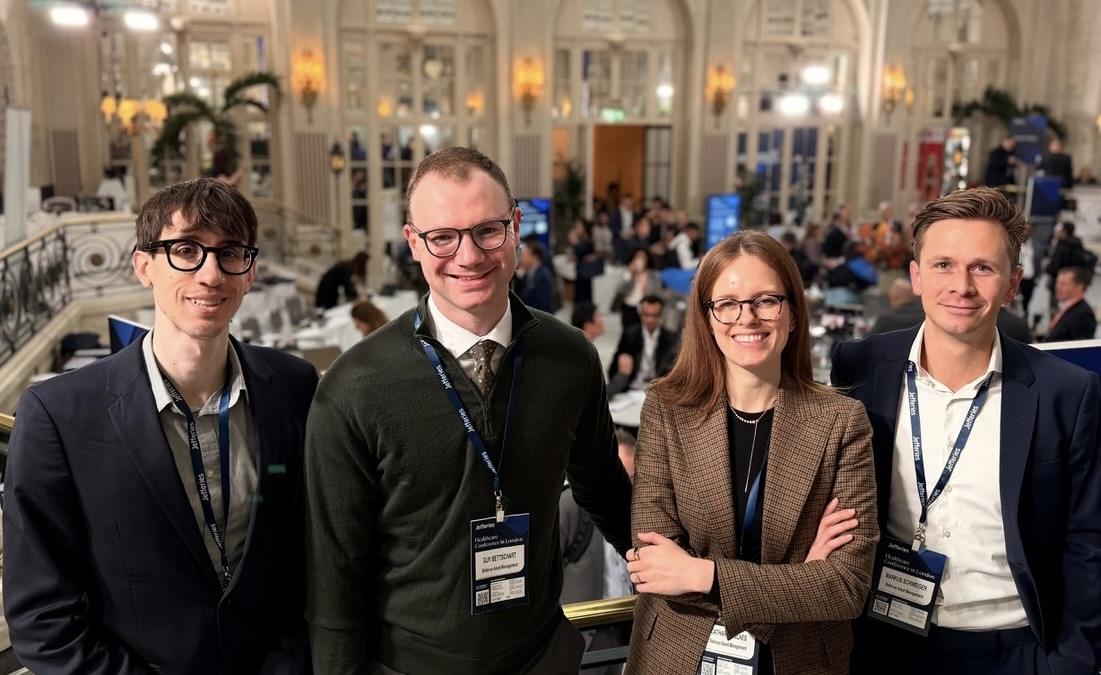
Photo: Bellevue Asset Management Healthcare Team
Guy Bettschart, Catharina Claes, Dr Markus Schweiger and Lorenzo Zignani of Bellevue Asset Management‘s Healthcare team attended the Jefferies Global Healthcare Conference, held in London from 16 to 19 November. With more than 5,000 participants and 1,000 companies represented, the event has established itself as Europe’s leading healthcare industry gathering.
The number of side events organised by other financial firms shows that the conference has reached critical mass. It now draws many people to London who aren’t attending the Jefferies conference itself.
Here are the key takeaways our team brought back from London:

The “most-favoured-nation” (MFN) agreements signed by 26 pharmaceutical companies are due to expire as scheduled in 2028, and we have heard of no meaningful new talks since the midterm elections. Even so, scrutiny of the sector is likely to return in 2027. Democrats in Congress have already asked manufacturers to hand over their agreements in unredacted form, and hearings are widely expected. Medicare’s transitional coverage for obesity drugs runs out at the end of 2027, so a decision will be needed next year. Proposals to revise the negotiation timelines set out in the Inflation Reduction Act cannot be ruled out either. Large-cap pharmaceutical stocks now trade at a premium to the broader US market for the first time since 2014–15, which leaves less room to absorb political surprises.
For these stocks to re-rate further, their pipelines and launches will have to deliver. Recent launches and filings are opening up areas that have seen little innovation for years: stroke prevention (Bayer’s asundexian), narcolepsy (Takeda’s Orzeyful), essential tremor (Praxis’s ulixacaltamide) and treatment-resistant depression (Compass Pathways’ COMP360). In coeliac disease, several mechanisms of action are being tested in clinical trials. These studies are also helping to define both the patient population and the disease itself more clearly.
Generic semaglutide is set to launch in Canada, Brazil and South Africa. This could be a meaningful opportunity for many companies, although price elasticity of demand remains a major unknown.
For three decades, pancreatic cancer was treated with generic chemotherapy. KRAS, the gene that drives most of these tumours, was considered undruggable. That changed in August, when Revolution Medicines’ daraxonrasib (Rasonque) became the first targeted therapy approved for the disease. It nearly doubled overall survival compared with chemotherapy. With almost $200 million in revenue in its first five weeks, it could prove to be one of the fastest launches in oncology history.
The debate is no longer about whether RAS can be targeted but about who will capture the value. Erasca is developing next-generation RAS inhibitors designed to be better tolerated. Tango, BeOne, Ideaya and Bristol Myers Squibb are combining PRMT5 inhibitors with RAS-targeted drugs. Revolution Medicines (zoldonrasib), Incyte and Verastem are going after the G12D variant, which is the most common one in pancreatic cancer and the one where daraxonrasib is less effective.
The next step is moving into earlier lines of treatment, where durability is the key question. These same drugs are also close to being used in colorectal and lung cancer. With big pharma actively involved through licensing deals and partnerships, we expect this to remain one of the most dynamic areas in oncology.
Sentiment in the sector has improved along with the rebound in share prices. Companies tied to reimbursed procedures that can’t be postponed came across as confident, with product launches and reimbursement decisions expected in 2027–28. These include diabetes technology, spine surgery, imaging and radiotherapy, transplantation, hearing, and cancer diagnostics.
Consumer-facing segments are bracing for a longer slowdown. These include clear aligners, dental implants, elective knee replacements and pet care.
The common thread across meetings was making innovation easier to adopt. Insulet aims to ease the daily burden of insulin therapy, while Glaukos focused on care pathways and the economics of eye-care practices. IDEXX sees room for more testing during existing vet visits. Software and AI at both IDEXX and Henry Schein can lighten administrative workloads.
By contrast, Baxter and Siemens Healthineers flagged near-term pressure on margins. As large players restructure or pull out of certain segments, specialist companies are attracting talent and gaining market share, which shows how much stock selection matters.
Read all our Inside articles