Cave de Genève
By André Bonetti, Workplace Safety Specialist

Drawing on my experience supporting Romandie-based companies, particularly in the construction sector, I have developed a comprehensive approach that combines workplace safety, health protection and environmental issues, notably through my training in safety and water protection. My background as a former industrial worker now allows me to address these issues with the right level of pragmatism.
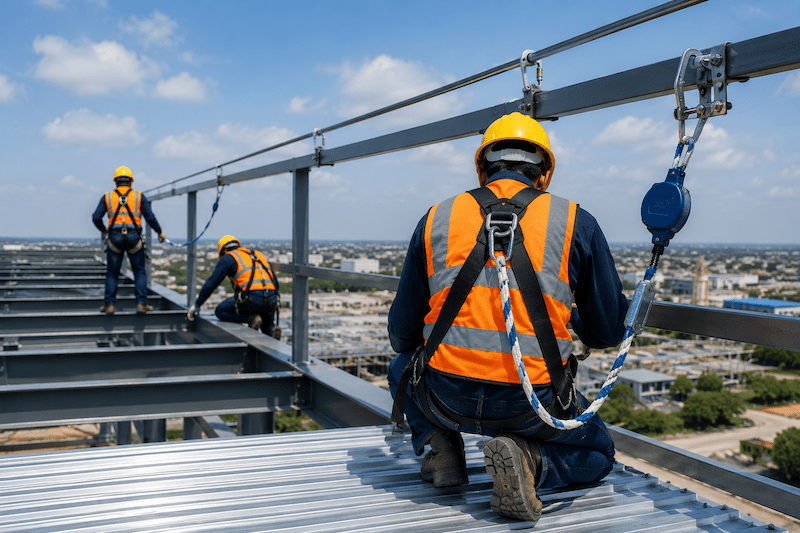
In recent years, a series of workplace accidents has marked our country, with tragic incidents involving crane collapses and scaffold failures. Compared with other developed countries where I have had the opportunity to speak, including Canada, we can see that our standards for protecting workers against accidents are more stringent. The same applies to health protection, for example protection against construction pollutants such as asbestos, where testing is mandatory and systematic.
Yet pure prevention still runs up against a deep cultural foundation: individual responsibility. This concept is inseparable from our militia system. Whether in politics, the army or civic engagement, our model is built on autonomy and personal accountability. In workplace safety, this translates into a strong expectation placed on the individual and the employer,
who are presumed to be the primary guardians of their own safety.

The challenge of federalism and site inspections: I would say that, in our country, the first point is very well executed and valued. By contrast, our federal structure introduces significant complexity. Although the ordinances are federal, cantonal sovereignty allows local requirements to be added. For a company operating across several cantons, this heterogeneity becomes a headache: the requirements during a site inspection can vary from one cantonal border to another, creating legal uncertainty for the employer as well as an added difficulty for the inspector.
Operational enforcement Then, the enforcement of these standards is an area that needs improvement. The state, namely the cantons and Suva, does not have sufficient human resources to inspect every site or every company at an appropriate frequency. Admittedly, the Labour Act and the Ordinance on Accident Prevention (OPA) delegate inspection responsibility to the employer, but in practice, without a strict accountability obligation, this self-monitoring reveals its limits. It is becoming imperative to introduce mandatory inspections (internal or external), with a frequency proportional to the size of the site and the level of risk.
The human factor and changing attitudes The human factor remains the most crucial. Attitudes toward danger are often linked to each person’s background and age. Forty years ago, society’s view of health (smoking, pollution) or safety (seat belts in cars) was radically different. This older culture still influences some experienced workers, who are very present on construction sites. By contrast, young people trained from the apprenticeship level onward integrate safety as a technical skill in its own right and put themselves less at risk.
Despite the recent tragedies involving crane or scaffold collapses, the 25-year record shows a 25% decline in serious accidents. This proves that better equipment and changing mindsets are delivering results, even if the path to “zero accidents” still requires stronger on-the-ground monitoring.
Find all our Inside articles