Difficulties in accessing housing — both due to scarce supply and financial barriers — are having a major impact on the career plans of Generation Z and millennials in Switzerland. For financial reasons, these young adults are putting off major life decisions.That is the finding of a new Deloitte study. Despite the financial pressure weighing on younger generations, they are less focused on career advancement. And by and large, young people have a positive view of AI.
For the fifteenth edition of Deloitte’s survey of Generation Z and millennials, the “Gen Z and Millennial Survey,” the audit and consulting firm questioned 22,595 people across 44 countries, including 400 in Switzerland: 300 members of Generation Z (born between 1995 and 2007) and 100 members of Generation Y, or “millennials” (born between 1983 and 1994). The findings show that young people in Switzerland now define success differently: stability, balance and flexibility matter as much as fast-tracked careers.
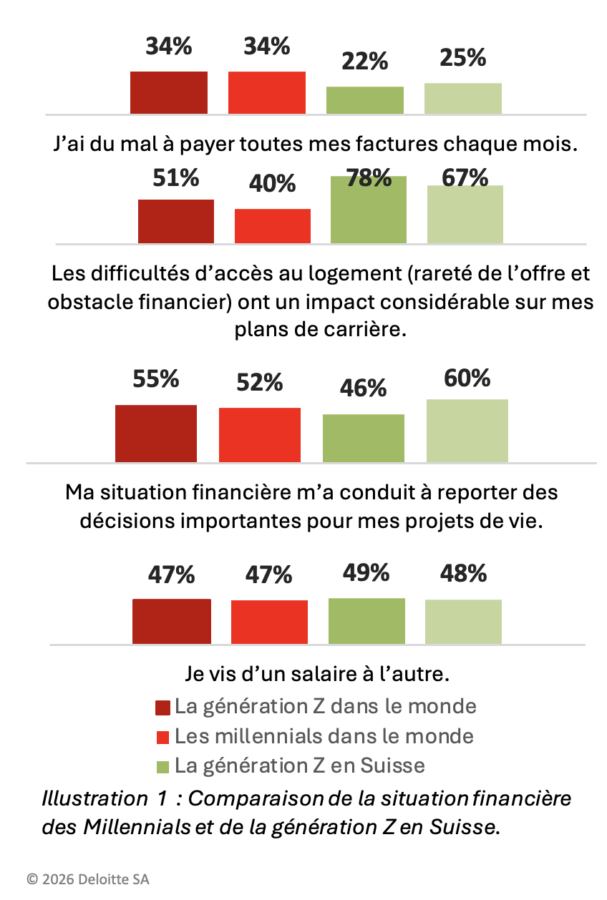
If young people in Switzerland are, overall, less affected by the cost of daily life than their peers elsewhere in the world (see illustration 1), financial concerns still play a significant role. Indeed, 78% of Generation Z respondents and 67% of millennials in Switzerland say the shortage of affordable housing has a major impact on their professional decisions, as well as on where they choose to work and live — a share notably above the global average.
Some 46% of Generation Z and 60% of millennials in Switzerland say their financial situation has led them to postpone major life decisions such as marriage, starting a family or continuing their education. Meanwhile, 54% of Generation Z respondents and 53% of millennials say they are unable to access home ownership — a figure well above the international average (51% for Generation Z, 40% for millennials). Nearly half of those surveyed in Switzerland say they live from paycheck to paycheck. That is also slightly above the global average. As a result, nearly a third of Generation Z respondents (31%) and just over two-fifths of millennials (41%) feel financially insecure.

“Switzerland is an attractive business location with high salaries. However, even young people with a solid education and a stable job are finding it increasingly difficult to buy a home. This is not just an individual problem; it is also a warning sign for Switzerland’s economy: if we want to attract and retain talent, policymakers must tackle the tightness of the Swiss property market head-on.”, says Michael Grampp, Chief Economist at Deloitte Switzerland.
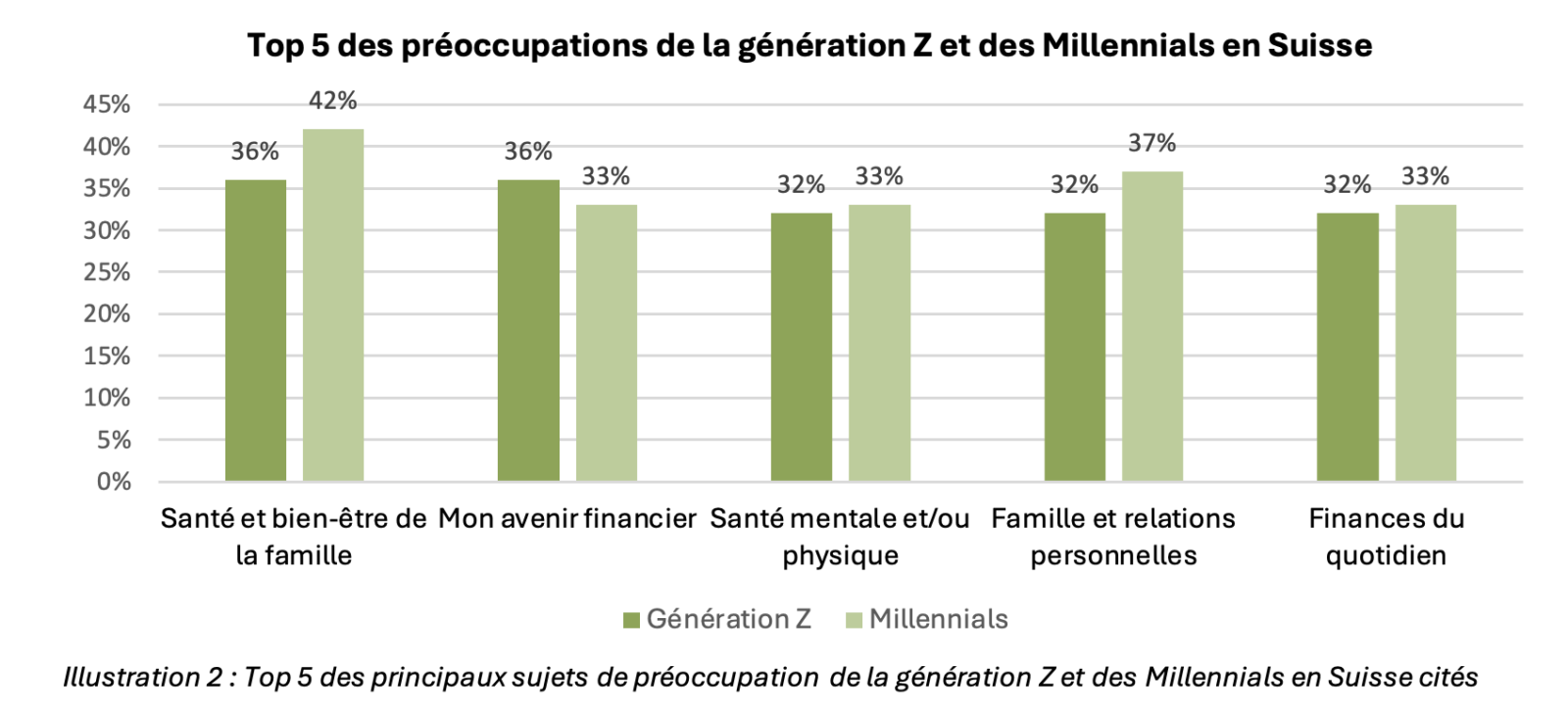
Financial matters rank high among the concerns of younger generations (see illustration 2). Yet despite worries about their financial situation, nearly one in five surveyed Generation Z and millennial respondents do not work full time or do not have a permanent job. For many respondents, the choice of a better work-life balance is a deliberate one: no fewer than 23% of Generation Z respondents and 20% of millennials cite “maintaining a good work-life balance” as their main objective — even ahead of career progression.
Generation Z and millennial respondents in Switzerland are less ambitious professionally than their peers in the rest of the world. The survey shows that only 33% of Generation Z respondents and 26% of millennials aspire to “steady career progression” (global comparison: 44% of young people in Generation Z, 45% of millennials). In Switzerland, 48% of Generation Z respondents and 57% of millennials would accept a management role in exchange for higher pay. Their willingness to aim for promotion depends on criteria they consider important: flexible working models, mental health support measures, leadership training and coaching.
“The old ‘title and salary’ arguments are no longer enough today to retain talent,” says Tiina Pokkinen, partner in Deloitte Switzerland’s Human Capital practice. “Employers must offer purpose, flexibility and effective support. Younger generations are deliberately investing in their mental and physical health and making time to nurture personal relationships, because they are aware of the greater long-term sustainability of such an approach. Companies need to adapt their mindset. By providing a working environment that offers meaning, flexibility and support, businesses can attract and retain committed employees. Those that ignore these expectations will not be able to keep talent.”
Companies have, however, become more aware of mental health issues: 78% of Generation Z respondents and 70% of millennials believe their employers take mental health seriously — a sharp increase compared with 2024 (Generation Z: 59%; millennials: 58%). Willingness to speak openly with managers about mental strain has also risen: 75% of Generation Z members and 70% of millennials feel able to raise the issue with their superiors.
Young generations have an upbeat view of digital technologies: by a large majority, AI is seen as having a positive impact on working life (81% of Generation Z and 77% of millennials) and on private life (87% of Generation Z and 80% of millennials) — well above the global average. In Switzerland, 73% of Generation Z respondents and 67% of millennials say they use AI in their day-to-day work.
“The debate around artificial intelligence is often dominated by fears that jobs will disappear,” Michael Grampp says. “Our study shows, however, that for these generations AI is not simply a threat to employment, but also a tool. They see it as an opportunity to automate repetitive tasks and refocus on work that feels meaningful. That is exactly the mindset we need to remain competitive.”
As part of Deloitte’s “Global Gen Z and Millennial Survey 2026,” a total of 22,595 people were surveyed, including 14,384 Gen Z respondents and 8,211 millennials from 44 countries across North America, Latin America, Europe, the Middle East, Africa and the Asia-Pacific region. In Switzerland, 400 people took part in the survey (300 Generation Z respondents and 100 millennials). The survey was conducted between 24 November 2025 and 19 January 2026. Deloitte defines the generations as follows: Generation Z, people born between January 1995 and December 2007; millennials, people born between January 1983 and December 1994.
Retrouvez l’ensemble de nos articles Culture Business