Photo © Valdemar Verissimo
By *Ivan Reusse, Leadership Development Director at Grant Alexander
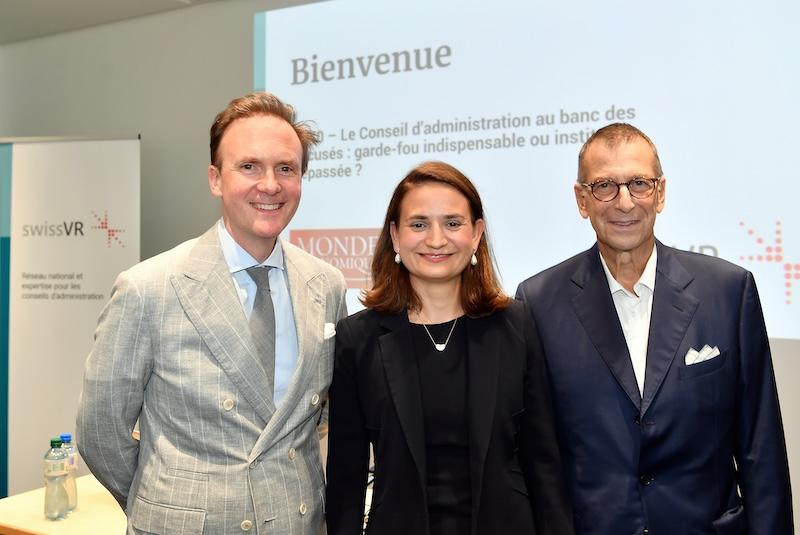
Recently, the editorial team of Le Monde Économique and SwissVR, the Swiss association for board members, took the bold step of putting corporate governance on trial. The event was hosted by Vaudoise Assurances in Lausanne. The setup was simple and remarkably effective: a prosecutor, a board of directors in the dock, a well-known Lausanne lawyer for the defense, a judge to preside, and the audience as the jury. The evening deserves praise: it turned a topic often seen as dry into a lively, at times funny, and above all clear-eyed debate. Behind the staging, every executive in the room recognized situations that are all too real.
Rather than go through every charge the prosecutor laid out in a deliberately lyrical closing argument, let us focus on those that come up most often in our boardrooms. First, a lack of structure. Too many boards operate without clear bylaws, without specialized committees, and without ever assessing their own performance. Then comes a lack of professionalism. A board seat is still too often seen as an honor rather than a demanding job that requires preparation, training and time.

Another charge is co-optation. People are chosen because we know them, because they think like us and because they will not rock the boat. This cronyism produces homogeneous boards whose members vote as a bloc to present a united front, at the expense of genuine debate. Unanimity may be reassuring, but it often masks an absence of real thought.
Availability is also an issue. The more board seats a director holds, the less time there is for each. Finally, the approach to risk is often skewed: some boards take risks without measuring them, while others take none at all. Worst of all is the inability to decide, which leaves the company without direction.
The evening highlighted a less visible but decisive issue: youth. Not the age on a birth certificate, but youthfulness of mind. Today’s board members must be able to adapt, understand new technologies and grasp emerging issues, from artificial intelligence to cybersecurity and sustainability.
We operate in a VUCA environment: volatile, uncertain, complex and ambiguous. Boards now have to navigate between danger zones, zones of effort and zones of uncertainty. In this context, yesterday’s certainties become vulnerabilities. That agility requires humility. Calling on outside experts when skills are lacking is not an admission of weakness. Knowing when to say no and when to say yes, analyzing rigorously, questioning oneself: these qualities were once rare around the board table. They are becoming indispensable.
The solutions are well known: recruit on the basis of skills rather than networks, diversify backgrounds and age groups, limit the number of board seats a director can hold, regularly assess how the board operates and provide ongoing training for its members. It is also essential to encourage constructive disagreement, the only real guarantee of sound decisions.
The mock trial organized by Le Monde Économique in collaboration with SwissVR convicted no one. Above all, it served as a reminder that good governance is not a luxury reserved for large listed companies. It is a matter of survival for every business. This original and bold event should prompt deeper reflection on how effective boards really are. It is now up to each board to deliver its own verdict, before events deliver it for them.
*About the author: A sociologist and economist by training, Ivan Reusse has 18 years of experience in multinational companies, where he led industrial operations, first in perfumery and then in pharmaceuticals, with particular expertise in the EMEA region. He later moved into strategy consulting and now heads the Leadership Development division in Switzerland at Grant Alexander, a consulting and HR services group specializing in executive search and leadership development. Fascinated by the complexity of the human factor and the strategic dynamics of organizations, he helps executives develop their leadership and transform their organizations.
Read all our Inside articles