Cave de Genève
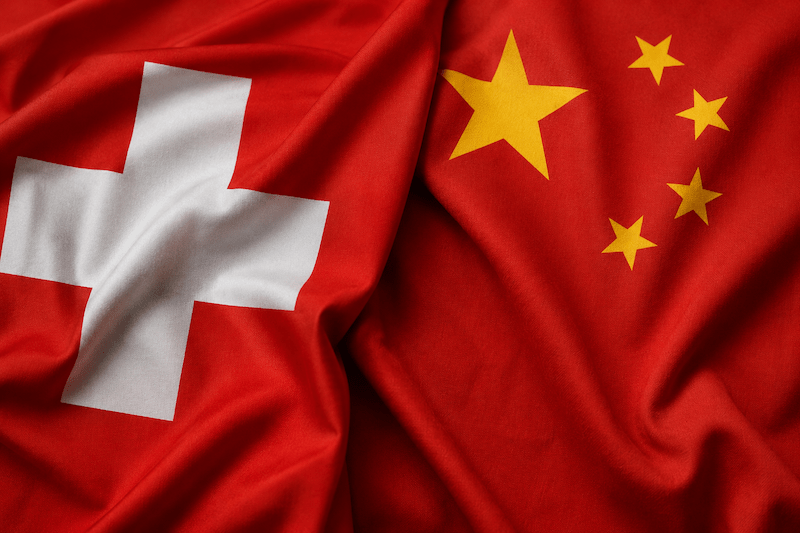
After two years of negotiations, Switzerland and China have concluded an agreement that will lift the share of Swiss exports exempt from customs duties from 50% to 99.8%. The text still needs to be signed and then ratified.
Switzerland and China took another step forward in their economic relations on Thursday. Federal President Guy Parmelin and Chinese Commerce Minister Wang Wentao announced in Bern the conclusion of talks aimed at modernising the free trade agreement between the two countries, which has been in force since 2014. The text has not yet entered into force, however. It must first undergo legal review, then be signed and submitted to the approval procedures required on both sides. The Swiss government is aiming for signature by the end of 2026. The main issue is access for Swiss products to the Chinese market. According to the State Secretariat for Economic Affairs (SECO), the current agreement already allows almost all Chinese imports to enter Switzerland duty-free. The reverse, however, was far less favourable to Swiss exporters and, until now, only around half of their sales in China benefited from an exemption. Under the upgraded version, 99.8% of current Swiss exports will eventually be able to enter the Chinese market without customs duties, a gain that particularly concerns chemicals and pharmaceuticals, precision instruments and watchmaking. The removal or reduction of customs duties improves market access conditions for these companies, without guaranteeing a mechanical rise in sales, as local demand, international competition, production costs and currency fluctuations will continue to weigh on results.
China occupies an important place in Swiss foreign trade and is now the country’s third-largest trading partner, behind the European Union and the United States. For Bern, improving access to this market is therefore also a way of diversifying outlets for Swiss companies. In a context of trade and geopolitical tensions, that diversification is all the more strategic for an economy as open to the outside world as Switzerland’s. SECO also points out that free trade agreements are designed above all to broaden access to foreign markets and strengthen national competitiveness. The text is not limited to customs duties either. The negotiators also worked on rules of origin, trade facilitation, trade in services and digital trade, competition, and economic and technical cooperation, with strengthened environmental provisions and labour rights. These elements matter just as much as tariffs themselves. For a company, simpler administrative procedures, the rules applicable to services or investment conditions can prove just as decisive as a percentage point of customs duty. The commercial rapprochement with Beijing comes at a sensitive international moment. China remains a major economic partner for Switzerland, but the relationship also raises questions of foreign policy, human rights and economic dependence. Bern presents the text as a tool to improve Swiss companies’ access to the Chinese market, and highlights the expansion of environmental and social provisions among the outcomes achieved. It will nonetheless be necessary to wait for the final publication of the agreement, and then its entry into force, to measure the real scope of these commitments. At this stage, the discussions are closed, but nothing is yet legally applicable. The legal review, signature and then the national approval procedures in both countries still have to be completed. Officially launched in September 2024, the negotiations ended after five rounds of discussions, the last of which took place in 2026, following nearly two years of work before this outcome was announced.
On paper, this modernised text represents a significant step forward for Switzerland. The move from around 50% to 99.8% of exports ultimately covered by tariff exemption is the most concrete change announced by Bern, while its extension to services, digital trade, competition and investment reflects the evolution of international trade since the original agreement was signed in 2014. But the true assessment will only be possible once it enters into force and the first economic results materialise. The removal of customs duties opens up opportunities, but it does not guarantee that companies will seize them. The next stage will therefore be legal and political. If signature and approval procedures proceed as planned, Switzerland will have a modernised trade framework with one of its main partners, leaving Swiss companies to turn this improved access into tangible business opportunities in an environment that remains highly competitive and uncertain.
Find all our Inside articles