Cave de Genève
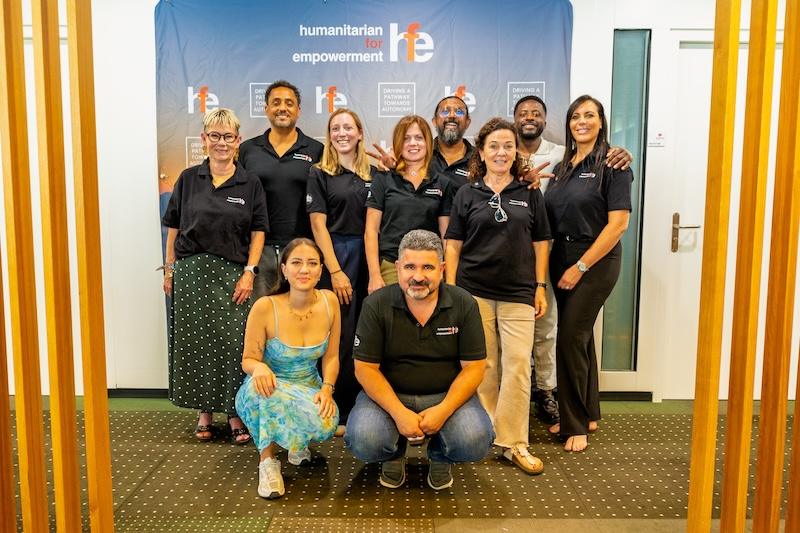
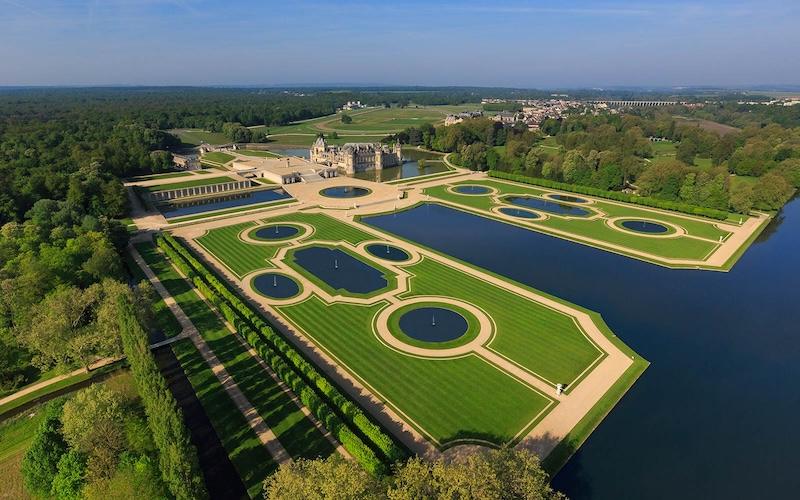
Photo © Jexterbarrionstudio
The international aid sector is going through a quiet crisis of models. Too many interventions, not enough transformation. Too many donations, not enough knowledge transfer. Faced with this dead end, organisations such as Humanitarian for Empowerment are helping to sketch, project by project, the contours of a radically different form of humanitarian action.
At the heart of contemporary humanitarian aid lies a contradiction that few dare to name plainly: the greater the needs become, the less capable intervention models seem to be of responding to them sustainably. Global financial flows dedicated to humanitarian aid have more than doubled in twenty years, yet the number of people living in vulnerable conditions has not declined. This paradox is not inevitable; it is a signal. It points to a sector that must reinvent itself, not at the margins, but at its very foundations.
It is precisely in this space for reinvention that associations such as Humanitarian for Empowerment (HFE) take on their full significance — not as commendable exceptions, but as laboratories for a possible form of humanitarian action: more effective, more sustainable, and more respectful of the communities it seeks to serve.

For decades, humanitarian aid was measured in volume: tonnes of food delivered, containers of medicine shipped, surgeons deployed to the field. Those indicators remain useful in acute emergency situations, but they also sustained an illusion — that providing relief was enough to deliver transformation.
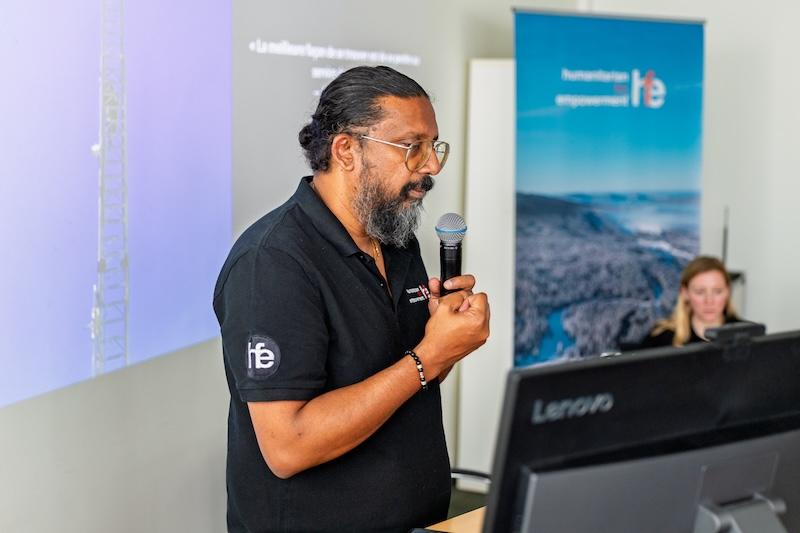
Dr Naiken Surennaidoo, founder of HFE, understood this through his own journey. A physician trained in Mauritius, Ukraine and Switzerland, he has seen from the inside what international aid produces when it is not accompanied by any transfer of skills. “Surgeons come, operate, make the headlines, but there is no transfer of know-how. Populations remain dependent,” he sums up. This observation, shared by a growing number of sector stakeholders, is reshaping the priorities of international aid.
The container era is drawing to a close.
The age of training is beginning.
One of the most striking lessons from HFE’s experience is the way the association combines technological innovation with local grounding, two dimensions that the traditional humanitarian sector has long treated as mutually exclusive. This tension is precisely what the new humanitarian model must learn to resolve. Organisations that deploy technological solutions without building the human ecosystems that sustain them — trained staff, adapted protocols, local ownership — generate short-lived effects. Those that invest in both at the same time create change that lasts beyond their own presence.
This is the logic HFE applies, whether in surgical training in Mauritius or educational support in Switzerland: technology and methodology in the service of people, never in their place. A simple principle, yet one whose rigorous application remains rare in the sector.
If one were to identify the central concept that distinguishes the new humanitarian model from the old, it would be that of invisible infrastructure. Roads, hospitals and schools are visible infrastructure; they can be photographed, financed and inaugurated.
Training local surgeons in laparoscopy, structuring a medical Journal Club, certifying community health workers: these are all invisible infrastructure. They do not make headlines. They endure. By training Mauritian surgeons in minimally invasive techniques, HFE is not solving a one-off surgical problem; it is permanently raising the skill level of an entire health system. By developing the Journal Club Circle, it is not delivering a course; it is embedding a culture of critical analysis that will continue to produce results long after the trainers have left.
It is this infrastructure logic that major funders — states, foundations and companies — are beginning to incorporate into their financing criteria. Measurable short-term impact remains a requirement, but the durability of results is becoming a criterion in its own right.
It is no coincidence that HFE was founded in French-speaking Switzerland. The country offers a unique ecosystem for this kind of initiative: a humanitarian tradition woven into its institutional DNA, a dense economic fabric open to partnerships, and an industrial base — watchmaking in particular — whose strong territorial roots are matched by a global outlook. The professional integration of displaced Ukrainian families into the watchmaking industry of the Vallée de Joux is a direct illustration of this: it shows HFE’s ability to mobilise local economic resources in support of a humanitarian mission. It is precisely this type of synergy between the private sector, the associative fabric and beneficiary communities that the new humanitarian model will need to systematise. Switzerland is well placed to play a central role in this reconfiguration — not merely as a funder, but as an incubator of exportable models.
No intellectual honesty would allow this overview to conclude without raising the questions that the HFE model itself has not yet resolved, questions that are precisely those the humanitarian sector as a whole will have to answer.
Can a model built on relational quality and knowledge transfer be scaled without being diluted? How can projects whose deepest effects only become visible after five or ten years be financed sustainably? How can major institutional donors be persuaded to accept success indicators that fall outside quarterly dashboards?
These questions do not weaken the model; they reveal its maturity. An organisation that does not ask them has not yet grasped the scale of what it has set in motion.
HFE asks them. And that may be its most valuable contribution to the contemporary humanitarian debate: not that it has found all the answers, but that it has identified the right questions.
Find all our Inside articles