Rédacteur : Patrick Ringgenberg
The nuclear agreement signed in the summer of 2015 raised hopes that political and commercial relations between Iran and the Western powers could finally normalise. Yet what do we really know about a country – Iran, long known as “Persia” – that has been marginalised and ostracised since the 1979 Islamic Revolution? More importantly, what can we know beyond official discourse, tourist imagery and journalistic dramatization, especially as there is a shortage of field-based academic research? The country is complex: through its history (cradle of the first sedentary civilisations, it was Iranicised at least as early as the 6th century BC), its geographical and geopolitical position (a crossroads between the West and the East, or Far East), its ethnic mosaic (a land of passage and synthesis, the Iranian Plateau has seen Iranians, Turks, Arabs and Mongols intermingle), its contrasts (urban and rural, centre and periphery, east and west), and, finally, its cultural dynamism.
For centuries, a tripartite tension has shaped Iranian identity: Iranian culture, crystallised into nationalism in the 20th century; Shiite Islam, infused with poetic mysticism; and Western influence, persistent despite the sometimes displayed anti-Americanism. These three cultural spheres continually overlap, shape one another or fade in and out of view in a living dialectic, variable across time, space and social groups, and therefore difficult to predict or conceptualise.

Thirty-eight years of Islamic Republic, a paradoxical blend of democracy and politico-religious authoritarianism, have also produced unprecedented cultural and psychological realities. Identity crises, generational divides, social and religious polarisation, and the “cultural schizophrenia” (Dariush Shayegan) have been heightened, transformed or complicated by the country’s isolation, social change and political upheavals.
Iran is not another planet, but it is certainly a different country, both East and West, and something else besides. For anyone seeking to understand it, only a long, humble and patient immersion can be recommended. After a brief stay in Iran, dazzled by the country’s beauty and the warmth of its people, one may believe one understands (almost) everything; but it is by facing, day after day, the “Soviet-style” maze of the administration, the volatility of human relations and situations, and the multidimensional nature of social codes that one begins to grasp the mountains to be moved and the depth of the “real” Iran. The Iranians’ warm hospitality and relational intelligence can indeed create the impression of an open and easily accessible society, whereas social life is in fact a complex, shimmering fabric, structured by networks, layers and compartments, and strongly polarised between the public sphere (with its prescribed, formal, political and religious behaviours) and the private sphere (where almost anything may be allowed, yet is still woven through with codes, unspoken rules and taboos).
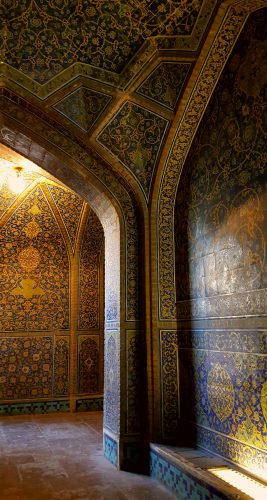 As the tiles adorning brick walls suggest, refinement in manners and family structures often conceal the harshness of relationships and the multiple personalities within each individual. Iranian politeness is both a dance of veils and a coded language: speaking Persian is of course essential, but knowing how to listen, and understanding symbols, gestures and poetry, may be even more important. Iranian time has its own rhythm too, marked by sharp contrasts – a short-term outlook colliding with administrative or traditional slowness – and one must learn to blend into it, accepting that “tomorrow” may mean tomorrow, the day after, or never. Iran is a country of “quantum” physics: a door can be simultaneously closed and open, a yes can sometimes be a problem, and a no is not always negative. It is also a land of the unexpected, or of “miracles”: solutions emerge when everything seems lost or impossible.
To these cultural difficulties must be added those linked to the contemporary political and ideological system, to social and quasi-structural issues (corruption, nepotism, clientelism, censorship), and to the current conjuncture, in which the Islamic Republic is confronting a new paradigm: establishing more open relations with a West perceived as imperialist and which, in fact, since the early 19th century, has never ceased trying to control the region through force or through murky diplomatic manoeuvring. Even so, these difficulties should not deter investors or entrepreneurs.
In addition to its natural wealth (oil, gas and metals) and human capital (a young, educated and talented population), Iran is also the region’s only stable country: its neighbours, from Iraq to Central Asia, are artificial or recently created nations, whereas Iran draws its identity strength from a deep history and a durable culture. These roots are the source of its present strength and, even more than its natural resources, they secure its future in a globalisation that divides as much as it connects.
About the author
A graduate in cinema (ESBA), religious studies (EPHE) and history (UniGe), Patrick Ringgenberg is the author of a book on Iran. His research focuses primarily on Islamic art and Iranian culture.