Neutrality, relations with the European Union, collective security: on all three fronts at once, Switzerland is being pressed to redefine what independence means in a world where no European country can truly stand apart from the others.
Switzerland is at a point where its traditional certainties are being tested by a world that has changed profoundly. For decades, it has been able to cultivate a singular position: independent, neutral, prosperous, firmly anchored in Europe without being part of the European Union, and open enough to the world to defend its economic and diplomatic interests. That formula long seemed to work, but the war in Ukraine, the return of great-power rivalry, Europe’s rearmament and trade tensions are now forcing Bern to re-examine the conditions of that independence. The question is therefore no longer simply whether Switzerland should remain independent, but what that independence actually means in a world where no European country can truly live apart from the others.
The debate on neutrality crystallises this shift. A popular initiative will be put to the Swiss people on 27 September 2026 to enshrine in the Constitution the principle of so-called “perpetual and armed” neutrality. The Federal Council, for its part, refuses to reduce neutrality to a policy of isolation and defends a concept that allows Switzerland to preserve its international room for manoeuvre, an essential distinction, since neutrality has never meant indifference. It can even become a genuine foreign-policy instrument, provided the country retains the means to defend its interests, engage with the world and contribute to collective security without ever becoming a party to it. This is precisely where Switzerland can still play an original role: its credibility does not rest on military or demographic power, but on its ability to provide spaces for dialogue, take part in mediation and defend international law. In 2026, it will chair the Organization for Security and Co-operation in Europe (OSCE) for the third time, after 1996 and 2014, a role that illustrates its ability to exert influence without seeking confrontation, drawing on long experience in international organisations and mediation processes. Its influence can therefore be real, provided discretion is not confused with withdrawal.
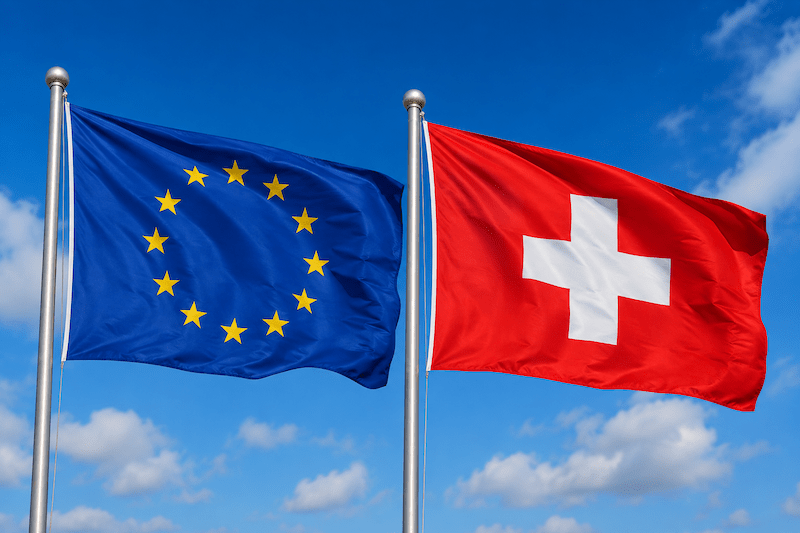
Relations with the European Union are the other major test. Switzerland is not a member of the EU and does not appear ready to become one in the near term. Yet its economy and security are deeply tied to the European continent. The new Switzerland-EU package of agreements, signed on 2 March 2026 in Brussels by Swiss President Guy Parmelin and European Commission President Ursula von der Leyen, aims precisely to stabilise this relationship and preserve access to the internal market while maintaining certain decision-making margins for the Confederation, a formula the Federal Council presents as a way to strengthen the country’s prosperity and security without giving up its institutional autonomy. That is probably where the real challenge lies: independence can no longer be understood as the ability to decide everything alone; in a globalised economy, it means retaining enough choice not to be at the mercy of others’ decisions. For a small power at the heart of Europe, cooperation is therefore not necessarily a surrender of sovereignty some partnerships can, on the contrary, strengthen its ability to defend its own interests, the difficulty being to determine how far to go without crossing the line beyond which cooperation becomes dependence. This search for balance also applies to security. Switzerland has long seen armed neutrality as the main guarantee of its autonomy, but the multiplication of threats, military, economic, cyber and energy-related makes that view more complex: the Federal Council intends to strengthen defence capabilities and deepen international cooperation in this area, while maintaining cooperation with NATO without becoming a member. This evolution does not necessarily mean abandoning neutrality; rather, it reflects an awareness that in a more dangerous strategic environment, autonomy also requires partnerships and domestic capabilities.

Switzerland will therefore have to avoid two symmetrical traps. The first would be to believe that independence requires keeping one’s distance from the world, at the risk of turning a strength, Switzerland’s distinctiveness, into a weakness by gradually diminishing the country’s influence. The second would be to assume that openness means systematically aligning with the great powers or with the European Union, which would amount to losing precisely what gives Switzerland its value: its ability to preserve a certain freedom of judgement. The right path may lie between these two extremes. An independent Switzerland is not necessarily a solitary Switzerland: it can be European without being a member of the Union, neutral without being passive, open to the world without renouncing its interests, and engaged in the security of the continent without abandoning its capacity to decide. The new international order is not asking it to renounce its model, but to adapt it.
Tomorrow’s true Swiss independence may be less about a country that rejects constraints than about one capable of choosing its dependencies, alliances and commitments. It is a more demanding concept of sovereignty: it requires knowing when to cooperate, when to resist and, above all, when to speak. If Switzerland succeeds in maintaining that balance, it could preserve something rare in the new Europe: the ability to be deeply engaged in the world without ceasing to be itself.
Find all our Analysis articles