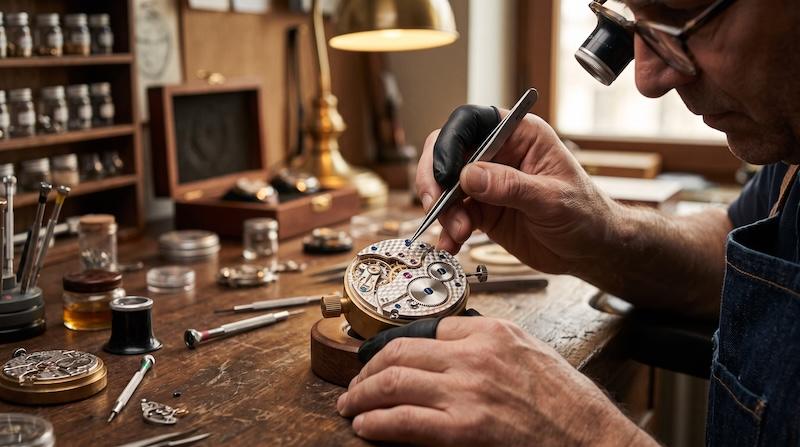
Major groups and independent creators are not experiencing the watch industry downturn in the same way. While the former can absorb the shock thanks to their financial firepower, the latter are exploring new markets, hoping to find, as they did during the quartz crisis, the idea that will breathe new life into the industry as a whole.
Swiss watchmaking is going through one of its most severe periods of turbulence in decades. After years of post-pandemic euphoria fuelled by strong demand and full order books, the tide has turned: Swiss watch exports have fallen for the third consecutive year running, hit by the collapse in luxury consumption in China and by higher US tariffs. While the Swiss ecosystem as a whole is feeling the slowdown, the entire value chain is being weakened, from subcontractors to retailers. The reality on the ground, however, reveals a clear divide: whereas the large luxury conglomerates and flagship brands are managing, however imperfectly, to cushion the blow thanks to their financial strength, it is independent creators and workshops that are paying the heaviest price today.
For a long time, the growth of independent brands rested on two major pillars: the United States and China, two markets that absorbed a significant share of output, drawn by the exclusivity, technical boldness and craftsmanship of these small workshops. Access to these outlets has become markedly more difficult, especially for independents, which lack the same commercial firepower as the major groups. In China, economic caution and changing consumption habits have sharply curbed impulse purchases; in the United States, higher tariffs and collectors’ caution in the face of tariff uncertainty have had a similar effect. Cut off from these historic engines, independents are now left with rising inventories and cash flow under pressure. They are therefore seeking to establish themselves in new territories to limit the impact: attention is turning in particular to Mexico and South America, regions with a well-established luxury culture and a growing affluent class, which represent promising ground for exploration. For the moment, however, results remain modest: sales are still weak, held back by logistical, tax and distribution hurdles that are slowing growth, so these new markets are nowhere near compensating for the outlets lost in China and the United States.
In Swiss workshops, the wait for a disruptive idea capable of unlocking the situation is becoming increasingly tangible. History reminds us that Swiss watchmaking has already reinvented itself through hardship, during the quartz crisis of the 1980s, when the arrival of Swatch shattered the industry’s codes, democratised access to the Swiss watch and gave vital momentum back to an industry that was then thought to be doomed.

In this forward-looking reflection, one continent is gradually becoming central to sector discussions: Africa, driven by sustained population growth, rapid urbanisation and the emergence of new local fortunes. Several major watchmaking and jewellery houses, such as Rolex, Chopard and Ulysse Nardin, are already present there through official retailers, notably in Nigeria and South Africa, a sign of a market already identified by part of the luxury industry. Understanding its cultural specificities, building lasting local partnerships and designing a tailored offer could make it possible to anticipate consumption patterns over the decades ahead, provided this is approached with a genuinely long-term vision rather than mere opportunistic diversification of export markets.
If vigilance is the order of the day, pessimism need not be the final answer. The history of Swiss master watchmakers is marked by trials and transformations. Every crisis they have faced has become a catalyst for innovation, forcing artisans to rethink their designs, materials, movements and business models. Independent creators have what industrial giants sometimes struggle to cultivate: remarkable agility, freedom of expression and a craft-driven commitment to excellence. It is precisely this ability to innovate off the beaten track that could enable these exceptional houses to weather the current storm and, tomorrow, find a durable path back to success.
Retrouvez l’ensemble de nos articles Décryptage