Cave de Genève
By Christophe Pouchoy, Managing Director, LFDE

There will be one million of them by 2030, and 3 billion in 2060, according to a Bank of America report[1]. Humanoid robots, a theme that has already resonated on the stock market, open up investment opportunities and dizzying prospects.
The rise of humanoids is one of the structural drivers of robotics growth, an industry powered by ever more efficient AI models, batteries and sensors. Projects are multiplying: Amazon announced last March the acquisition of a start-up behind a domestic humanoid, while Chinese company UBTech has just entered into a partnership with a subsidiary of German group Siemens aimed at deploying new humanoids. Industry and many other sectors, in our view, will benefit from this revolution.
Whereas humanoid programming used to consist of numerous lines of code, physical AI is now integrated directly into robots, enabling them to adapt to their environment through sensors that analyze collected data to reason and act in the real world. Physical AI is the brain of robotics. According to Barclays, the physical AI market could be worth $500 billion to $1.4 trillion by 2035.

A productivity driver, robotics offsets the decline in the global workforce and is transforming many sectors, from logistics to agriculture. And the automated factory of the future already exists, with more than 4.5 million industrial robots around the world and growth of 540,000 new robots installed in 2024, a record[2]. The medical robotics market, for example, built by pioneers such as Intuitive, Stryker and Thermo Fisher, is expected to reach $138.5 billion in 2034[3]. The autonomous vehicles market, or robotaxis, is meanwhile estimated at more than $2 trillion in 2040[4].
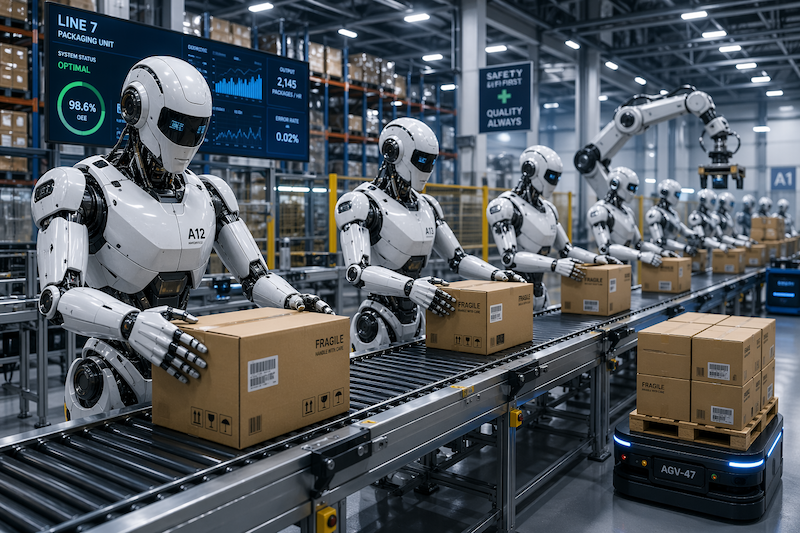
Added to this is humanoid robotics, whose use is emerging within industries. Swedish company Hexagon has developed Aeon, its humanoid, which integrates several Nvidia solutions. Capable of performing a wide range of tasks, from selecting to inspecting objects, Hexagon plans to develop it in the industrial sector.
The new players, capable of designing profitable humanoid robotics AI solutions, will play a major role in its global adoption. The humanoid segment is currently dominated by China, where 85% of the humanoid robots developed in the world in 2025 are installed. The country has made it a national priority and is multiplying its champions, such as UBTech Robotics, Agibot, which plans to go public in 2026, Xiaomi, BYD, and sector leader Unitree Robotics, which delivered nearly 5,500 units in 2025. As the technologies used for these robots and autonomous vehicles are similar, American players such as Tesla are positioning themselves in both sub-segments. In Europe, where the industrial tradition is long-standing, adoption is driven by large groups, such as Airbus, which uses them to transform its production sites or make its products smarter.
The rise of humanoid robots in the real economy should accelerate as their production costs fall, averaging $50,000 today compared with $1.5 million five years ago. On par with that of the automotive industry, this revolution opens up long-term opportunities that we aim to capture through our Echiquier Robots and Humanoids strategy.
Disclaimer : These data, opinions, sectors and values are provided for information purposes only and do not constitute an offer to buy, investment advice or financial analysis. The fund is mainly exposed to the risk of capital loss, equity risk, currency risk, emerging market risk and discretionary management risk. For more information, please consult the regulatory documents on www.lfde.com. Investors are advised that the units/shares presented may not be available for distribution in their country.
[1] March 2025
[2] International Federation of Robotics, 2024
[3] Vantage Market Research, 2024
[4] Id., 2024
Find all our articles Economy