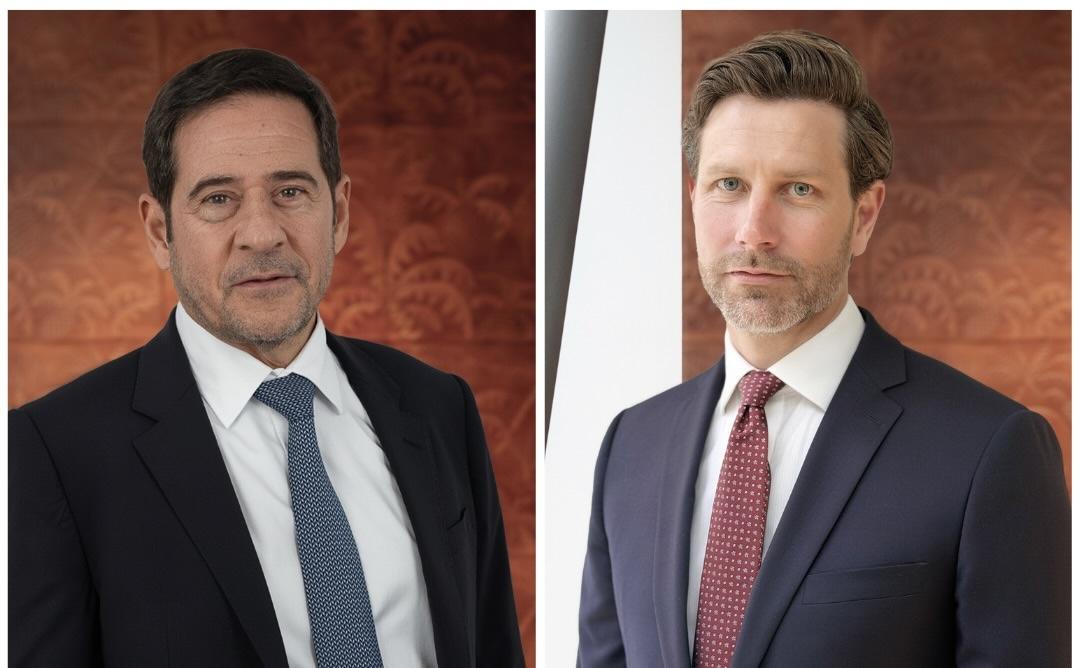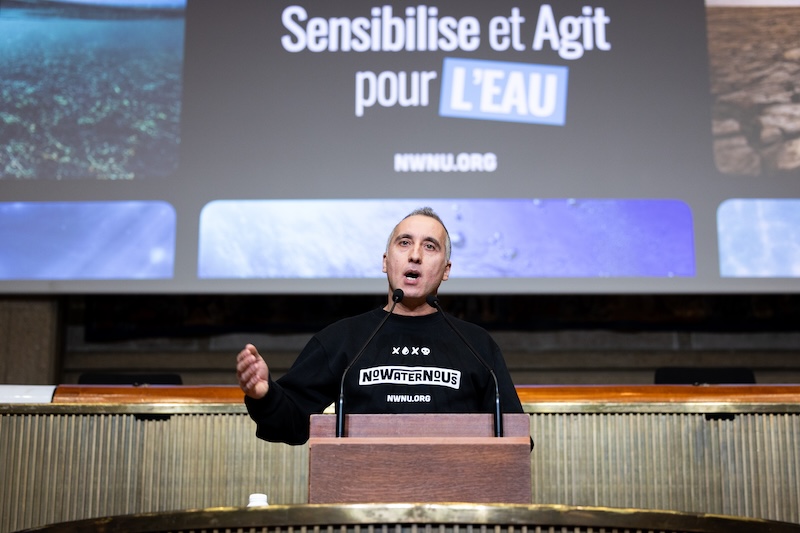
Photo from the No Water No Us summit in Geneva 2026, from left to right: Malek SEMAR – Keith JAMES – Massimiliano Mayrhofer ©️ Houssam Khaled
Malek Semar “Water is not the problem: it is the solution. What threatens us is dirty water.”
For a long time, water was viewed as an abundant, taken-for-granted resource. Today, however, its systemic fragility is becoming impossible to ignore: widespread contamination, overstretched infrastructure, competing uses, territorial vulnerability and a growing dependence on globalised economies. Far from being merely an environmental issue, water is emerging as a factor of stability, competitiveness and sovereignty. For businesses and governments alike, understanding its dynamics, risks and opportunities is no longer optional; it is a prerequisite for resilience. In this context, Malek Semar, founder of No Water No Us, offers a radically different perspective. For him, the water crisis is not a scarcity crisis, but a pollution crisis; and the solution lies not in reducing consumption, but in controlling the cycle and systematically treating wastewater.
Through his advocacy with decision-makers and his work on the ground with the most vulnerable communities, he champions a simple, powerful conviction: clean water is the foundation of all human and economic prosperity. In this interview, he decodes the mechanics of the crisis, the structural obstacles, the levers for action and the outlook for a sector that is set to become one of the decade’s most strategic.

Monde Économique: The water crisis has become a global issue. How would you actually define it?
Malek Semar: People often talk about water scarcity, but that is a fundamental misconception. The amount of water on Earth has been exactly the same for 4.5 billion years. What we still do not understand well is water itself. The real problem is not scarcity, but contamination. Today, 80% of wastewater worldwide is discharged into nature untreated. Every day, we pollute the very resource on which all life depends, and every economic activity as well. We are not facing a future risk: we are already in a present, massive, systemic crisis. And we no longer have the capacity to solve it entirely; all we can do now is limit its consequences.
Monde Économique: The water crisis is often seen as a distant issue affecting arid regions or developing countries. Yet its economic impact is now being felt across the planet. What risks does it pose to the global economy and to a country like Switzerland?
Malek Semar: Water knows no borders. A tomato served in Geneva may have been irrigated on the other side of the world the day before. If that water is contaminated, you are importing contamination. The United Nations now speaks of a “global water bankruptcy”, where water systems can no longer return to their original state. This situation is already costing the global economy hundreds of billions in lost productivity, geopolitical tensions, health impacts and disruption to agriculture. Switzerland, despite its water resources, is not protected. It depends on globalised supply chains, foreign agricultural production and infrastructure that must be adapted. Even a benchmark country cannot protect itself on its own: if the rest of the world does not treat its wastewater, contamination comes back through the global cycle.
Monde Économique: Although water is often perceived as an abundant, self-evident resource, you chose to dedicate your commitment to one of the most underestimated crises of our time. Why did you found No Water No Us, and what is your mission?
Malek Semar: It all started with that figure: 80% untreated wastewater. I became aware of it in 2019, while studying water management at the University of Geneva. And I discovered not only the scale of the problem, but also the lack of collective mobilisation commensurate with the challenge. That is when I decided to act. From that conviction came No Water No Us, an organisation built around two fundamental verbs: raise awareness and act. First, raise awareness, because nothing will change if political and business leaders do not understand that clean water is the foundation of all prosperity. They need to see that this is not an environmental issue, but a strategic one. The organisation therefore develops advocacy, conferences, educational content and institutional partnerships to put water back at the heart of public and private priorities.
But awareness alone is not enough. There must also be concrete action, directly with those who experience the water crisis every day. No Water No Us therefore works with indigenous peoples, who are often the hardest hit by contamination and the lack of infrastructure, as well as with primary schools, where habits and basic reflexes are passed on. We want to show a desirable future, not create guilt. To imagine what the world could become if clean water were available everywhere. And on the ground, to prove that solutions exist, that they are accessible and that they change lives.
This dual approach — convincing decision-makers from the top down, changing practices from the bottom up — is the organisation’s signature.
Monde Économique: What is preventing large-scale action today?
Malek Semar: The first obstacle is economic: dumping dirty water costs nothing. Treating water costs money. As long as pollution is free, the temptation is enormous. The second obstacle is cultural: we live in a world where money comes before life. Between “the end of the month” and “the end of the world”, the choice is quickly made. The third obstacle is financial: treating water is becoming increasingly expensive because we have allowed pollutants to accumulate. Today, even rainwater contains microplastics. We are paying the price of a historical backlog.
Monde Économique: Given the scale of a challenge that still leaves two billion people without access to drinking water, the question of solutions is central. What realistic approaches are there for the years ahead?
Malek Semar: The solutions exist. Since 2010, the United Nations has recognised water as a human right. But a right is meaningless without governance. We need global governance, because water circulates; local solutions, because uses are territorial; massive funding to catch up; and collective awareness to stop discharging dirty water. Today, two billion people do not have access to drinking water and five billion live without sanitation. We will not close that gap without a global, public and private effort.
Monde Économique: What message would you like to send to executives and business leaders?
Malek Semar: Look at the world map: the most advanced countries are those that manage water systemically — drinking water, wastewater, treatment, reuse. That is no coincidence. Water is the foundation of all prosperity. Companies must integrate water into their strategy: securing supply chains, reducing operational risks, innovating in treatment and reuse, building public-private partnerships, investing in water technologies. Water is not an environmental issue. It is an economic, strategic and geopolitical one.
Retrouivez l’ensemble de nos Interviews