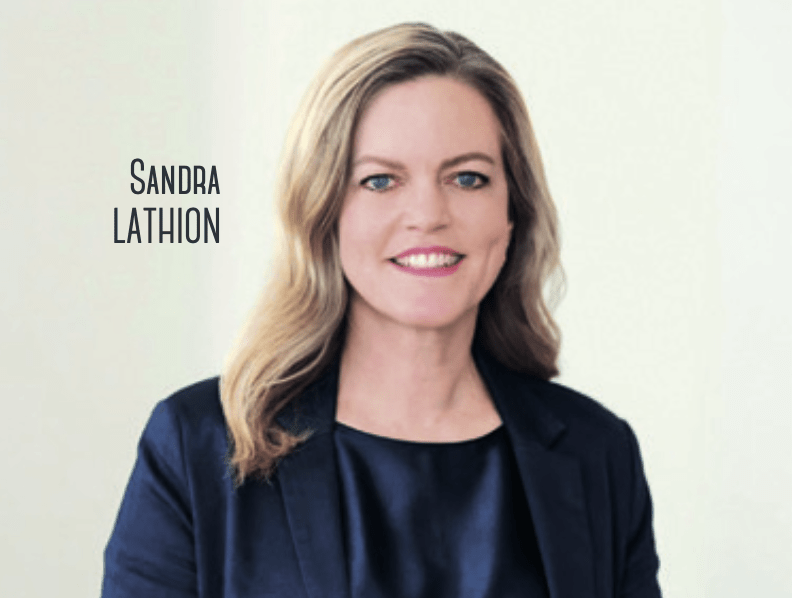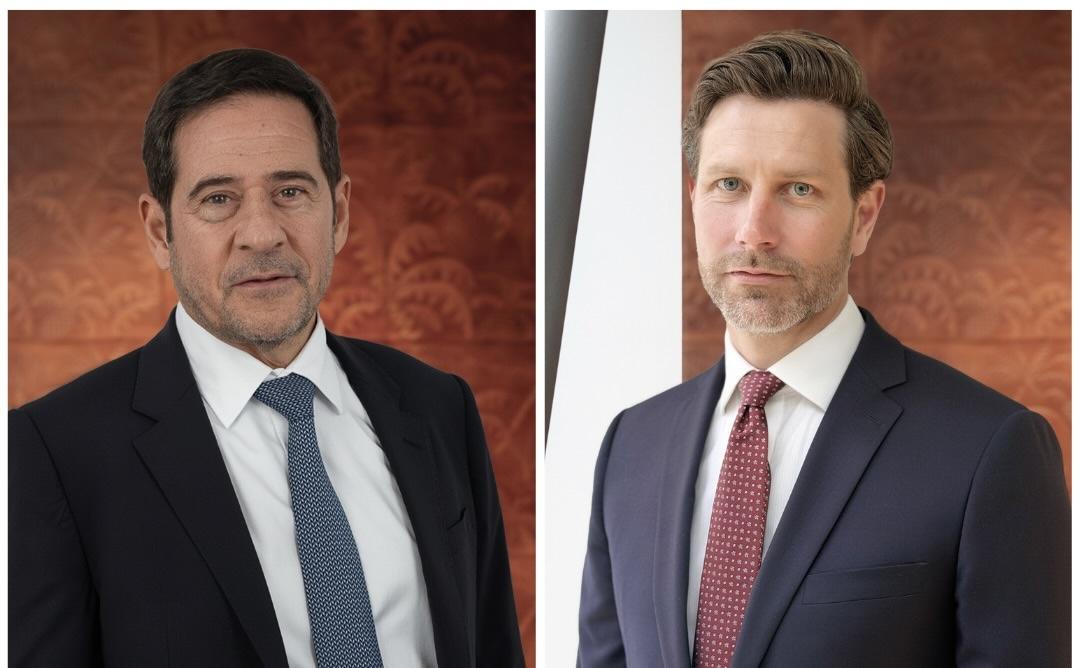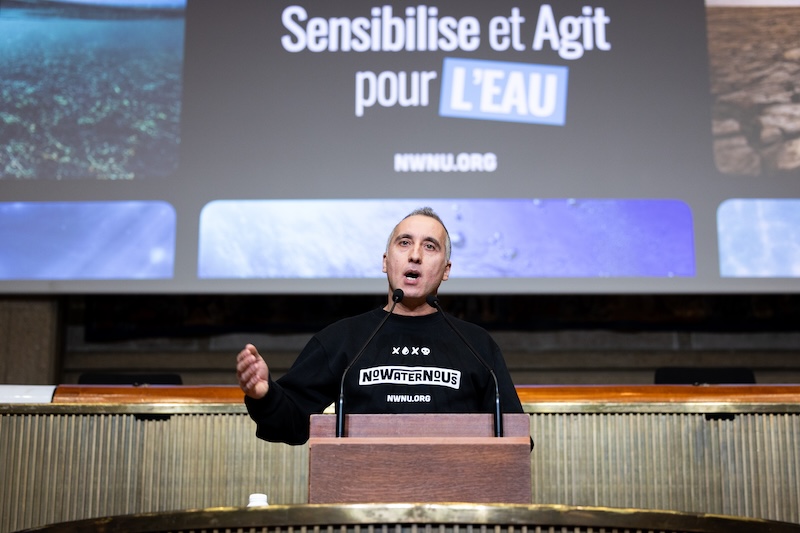
Photo from the No Water No Us summit in Geneva 2026, from left to right: Malek SEMAR – Keith JAMES – Massimiliano Mayrhofer ©️ Houssam Khaled
Malek Semar “Water is not the problem: it is the solution. What threatens us is dirty water”.
Long seen as an abundant and taken-for-granted resource, water is now revealing its systemic fragility: massive contamination, overburdened infrastructure, competing uses, territorial vulnerabilities and growing dependence within globalised economies. Far from being a purely environmental issue, water has become a factor of stability, competitiveness and sovereignty. For companies as well as states, understanding its dynamics, risks and opportunities is no longer optional, but a condition of resilience. It is in this context that Malek Semar, founder of No Water No Us, offers a radically different reading. For him, the water crisis is not a scarcity crisis, but a pollution crisis; and the solution does not lie in reducing consumption, but in controlling the cycle and systematically treating wastewater.
Through his advocacy with decision-makers and his work in the field alongside the most vulnerable communities, he defends a simple and powerful conviction: clean water is the foundation of all human and economic prosperity. In this interview, he decodes the mechanics of the crisis, the structural barriers, the levers for action and the outlook for a sector set to become one of the most strategic of the decade.

Monde Économique : The water crisis has become a global issue. How would you define it in practical terms?
Malek Semar : People often talk about water scarcity, but that is a fundamental mistake. The amount of water on Earth has remained strictly the same for 4.5 billion years. What we still do not properly understand is water itself. The real problem is not scarcity, but contamination. Today, 80% of wastewater worldwide is discharged into nature without any treatment. Every day, we pollute the resource on which every form of life depends, but also every economic activity. We are not facing a future risk: we are already in a present, massive, systemic crisis. And we no longer have the capacity to solve it completely; we can only limit its effects.
Monde Économique : The water crisis is often seen as a distant issue, specific to arid regions or developing countries. Yet its economic repercussions now affect the entire planet. What are the risks for the global economy, and for a country like Switzerland?
Malek Semar : Water has no borders. A tomato served in Geneva may have been irrigated the day before on the other side of the world. If that water is contaminated, you import the contamination. The United Nations now speaks of a “global water bankruptcy,” in which water systems can no longer return to their initial state. This situation is already costing the global economy hundreds of billions in lost productivity, geopolitical tensions, health impacts and agricultural disruptions. Switzerland, despite its water resources, is not immune. It depends on globalised supply chains, foreign agricultural production and infrastructure that will need to be adapted. Even an exemplary country cannot protect itself alone: if the rest of the world does not treat its wastewater, contamination comes back through the global cycle.
Monde Économique : While water is often perceived as an abundant and taken-for-granted resource, you have chosen to dedicate your commitment to what you see as one of the most underestimated crises of our time. Why did you create No Water No Us, and what is your mission?
Malek Semar : It all started with this figure: 80% of wastewater untreated. This realisation came in 2019 while I was pursuing a diploma at the University of Geneva dedicated to water management. And I discovered not only the scale of the problem, but also the absence of collective mobilisation equal to the challenge. That is when I decided to act. From that conviction came No Water No Us, an organisation built around two founding verbs: raise awareness and take action. Raise awareness first, because nothing will change unless political and business leaders understand that clean water is the foundation of all prosperity. They must be shown that this is not an environmental issue, but a strategic one. The association therefore develops advocacy actions, conferences, educational content and institutional partnerships to bring water back to the centre of public and private priorities.
But awareness is not enough. We must also act, concretely, alongside those who live the water crisis every day. No Water No Us therefore works with Indigenous peoples, who are often the most exposed to contamination and lack of infrastructure, as well as primary schools, where the transmission of essential behaviours and habits takes shape. We want to show a desirable future, not to assign blame. To imagine what the world could become if water were clean everywhere. And to prove, on the ground, that solutions exist, that they are accessible and that they change lives.
This two-pronged approach — convincing decision-makers from the top down, transforming practices from the bottom up — is the organisation’s signature.
Monde Économique : What is preventing large-scale action today?
Malek Semar : The first barrier is economic: dumping dirty water costs nothing. Treating water costs money. As long as pollution is free, the temptation is huge. The second barrier is cultural: we live in a world where money takes precedence over life. Between “the end of the month” and “the end of the world,” the choice is quick. The third barrier is financial: treating water is becoming ever more expensive, because we have allowed pollutants to accumulate. Today, even rainwater contains microplastics. We are paying the price of a historical delay.
Monde Économique : Faced with the scale of a challenge that still affects two billion people without access to drinking water, the issue of solutions becomes central. What are the realistic paths for the years ahead?
Malek Semar : The solutions exist. Water has been recognised by the UN as a human right since 2010. But a right is meaningless without governance. We need global governance, because water flows across borders; we need local solutions, because uses are territorial; we need massive funding, to close the gap; and we need collective awareness, to stop dumping dirty water. Today, two billion people do not have access to drinking water and five billion live without sanitation services. We will not make up for this delay without a global effort, from both the public and private sectors.
Monde Économique : What message would you like to convey to executives and business leaders?
Malek Semar : Look at the world map: the most developed countries are those that manage water systemically — drinking water, wastewater, treatment, reuse. That is not a coincidence. Water is the foundation of all prosperity. Companies must integrate water into their strategy: securing supply chains, reducing operational risks, innovating in treatment and reuse, public-private partnerships, investment in water technologies. Water is not an environmental issue. It is an economic, strategic and geopolitical issue.
Find all our Interviews