Chart © SSPA
July was marked not only by weather extremes: capital markets, too, saw no real summer respite. In the United States, sharp volatility and losses among semiconductor and artificial intelligence stocks dominated trading. At times, optimism around continued growth in investment spending prevailed. At other times, concerns took over, as investors feared that valuations and earnings expectations were already pricing in too much of future growth. This also weighed on Japanese equities, while European markets ultimately ended the month higher.
Several factors weighed on investor sentiment at the same time. In the Middle East, hopes for a peace deal alternated with renewed fears of escalation. The result was a marked increase in oil prices. Crude rose by about 20% over the course of July, posting its strongest monthly gain since March. Inflation and interest-rate risks therefore moved back into the spotlight. Although the US Federal Reserve and the European Central Bank both left their policy rates unchanged at their latest monetary policy meetings, markets now expect rate hikes in September, both in the United States and in the euro area.
Earnings season, by contrast, provided some support. By the end of July, around 300 S&P 500 companies had reported results. According to LSEG data, the index is on track for second-quarter earnings growth of 29.3% compared with the same period last year. The estimate had previously stood at 27%.

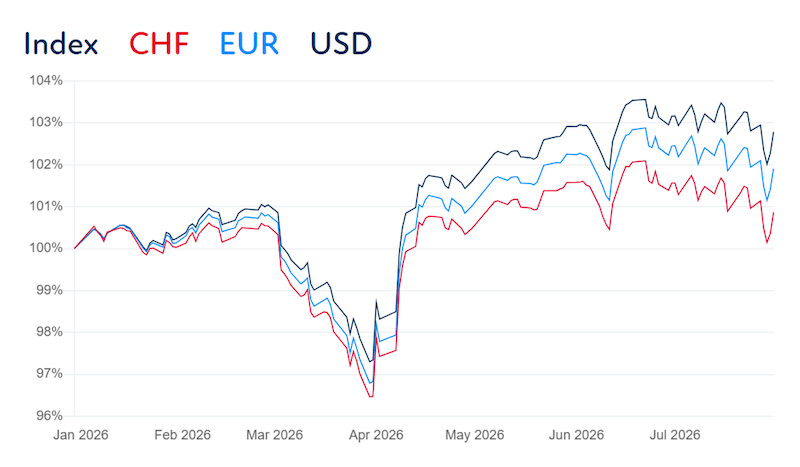
This created a mixed backdrop for the SSPA Benchmark Index. The index is based on standardised worst-of Barrier Reverse Convertibles linked to the S&P 500, the EURO STOXX 50 and the Nikkei 225. It therefore represents a systematic yield-optimisation portfolio denominated in CHF, EUR and USD.
Stronger resilience in European equity markets had a stabilising effect. At the same time, weakness in US technology stocks and heightened nervousness once again brought barrier-breach risk into focus. At the start of July, the index remained stable and temporarily moved slightly above the 100% mark. Volatility then picked up. Towards the end of the month in particular, all three currency tranches came under visible pressure. Each recorded a negative performance in July, with the USD tranche still posting the strongest result ahead of the EUR and CHF tranches.
Rising volatility has a twofold effect on Barrier Reverse Convertibles: in the short term, it can increase pricing pressure and the risk of barriers being breached, while at the same time supporting more attractive coupon conditions for new products. This was also reflected in the latest monthly rebalancing.
At the end of July, new Barrier Reverse Convertibles were added to the index with coupons of 12.16% in USD, 10.46% in EUR and 7.91% in CHF. At the end of June, the corresponding levels had still stood at 11.88%, 10.03% and 7.54%, respectively. Coupons therefore increased again across all three currency tranches.
In August, corporate results, monetary policy, geopolitical developments and market dynamics linked to artificial intelligence are expected to remain key drivers for equity markets, volatility and the valuation of structured products.
Retrouvez l’ensemble de nos Communiqués